Robustness
Outlier handling through iterative reweighting.
How Robustness Works
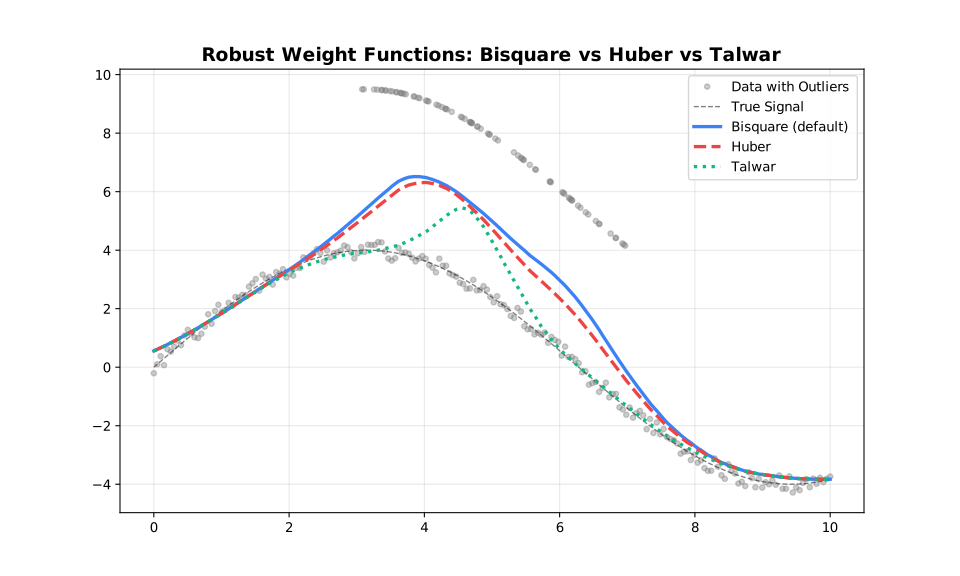
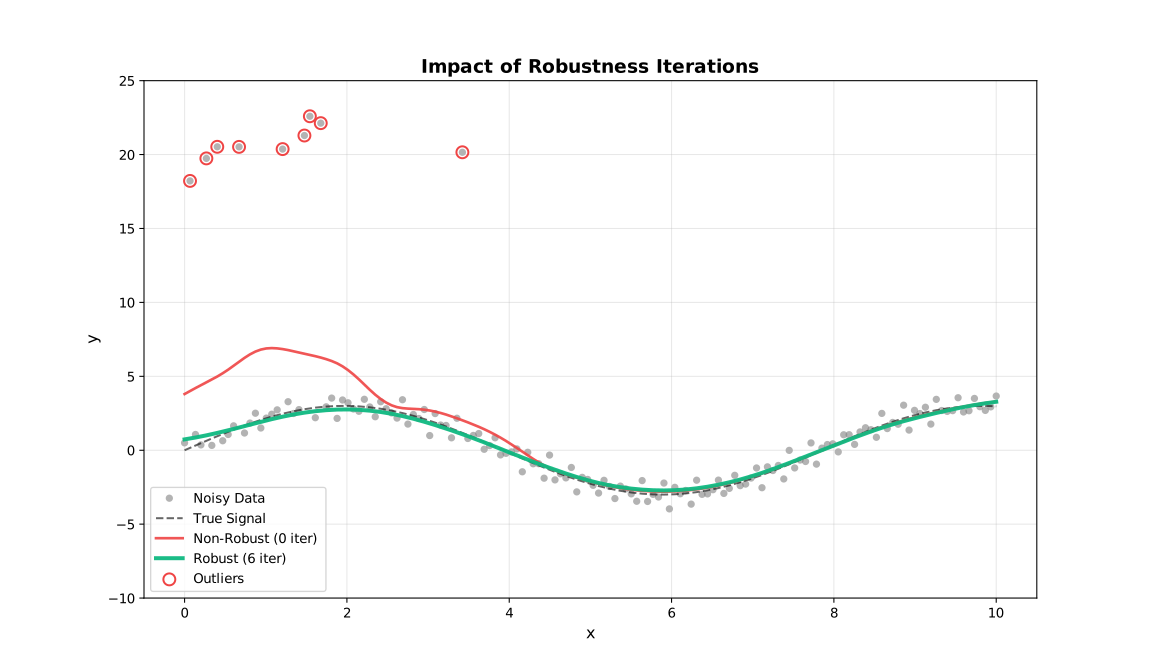
Standard LOWESS can be biased by outliers. Robustness iterations downweight points with large residuals:
- Fit initial LOWESS
- Compute residuals
- Assign robustness weights (large residuals → low weight)
- Refit using combined distance × robustness weights
- Repeat steps 2–4
Robustness Methods
Bisquare (Default)
Smooth downweighting. Points transition gradually from full weight to zero.
Use when: General purpose, balanced approach.
use fastLowess::prelude::*;
use std::f64::consts::TAU;

fn main() -> Result<(), LowessError> {
    let n = 100usize;
    let x: Vec<f64> = (0..n).map(|i| i as f64 * TAU / (n - 1) as f64).collect();
    let y: Vec<f64> = x.iter().map(|&xi| xi.sin() + 0.1).collect();

    let model = Lowess::new()
        .iterations(3)
        .robustness_method("bisquare")
        .build()?;
    let result = model.fit(&x, &y)?;

    Ok(())
}
const { Lowess } = require('fastlowess');

const n = 100;
const x = Float64Array.from({ length: n }, (_, i) => i * 2 * Math.PI / (n - 1));
const y = Float64Array.from(x, (xi, i) => Math.sin(xi) + (((i * 7 + 3) % 17) / 17 - 0.5) * 0.6);

const model = new Lowess({ iterations: 3, robustness_method: "bisquare" });
const result = model.fit(x, y);
import init, { Lowess } from 'fastlowess-wasm';
await init();

const n = 100;
const x = Float64Array.from({ length: n }, (_, i) => i * 2 * Math.PI / (n - 1));
const y = Float64Array.from(x, (xi, i) => Math.sin(xi) + (((i * 7 + 3) % 17) / 17 - 0.5) * 0.6);

const model = new Lowess({ iterations: 3, robustness_method: "bisquare" });
const result = model.fit(x, y);
#include <fastlowess.hpp>
#include <cmath>
#include <iostream>
#include <vector>

int main() {
    const int n = 100;
    std::vector<double> x(n), y(n);
    for (int i = 0; i < n; ++i) {
        x[i] = i * 2 * M_PI / (n - 1);
        y[i] = std::sin(x[i]) + 0.1;
    }

    fastlowess::Lowess model({ .iterations = 3,
        .robustness_method = "bisquare"
     });
    auto result = model.fit(x, y).value();

    return 0;
}
Huber
Linear penalty beyond threshold. Less aggressive than Bisquare.
Use when: Moderate outliers, want to retain some influence.
use fastLowess::prelude::*;
use std::f64::consts::TAU;

fn main() -> Result<(), LowessError> {
    let n = 100usize;
    let x: Vec<f64> = (0..n).map(|i| i as f64 * TAU / (n - 1) as f64).collect();
    let y: Vec<f64> = x.iter().map(|&xi| xi.sin() + 0.1).collect();

    let model = Lowess::new()
        .iterations(3)
        .robustness_method("huber")
        .build()?;
    let result = model.fit(&x, &y)?;

    Ok(())
}
const { Lowess } = require('fastlowess');

const n = 100;
const x = Float64Array.from({ length: n }, (_, i) => i * 2 * Math.PI / (n - 1));
const y = Float64Array.from(x, (xi, i) => Math.sin(xi) + (((i * 7 + 3) % 17) / 17 - 0.5) * 0.6);

const model = new Lowess({ iterations: 3, robustness_method: "huber" });
const result = model.fit(x, y);
import init, { Lowess } from 'fastlowess-wasm';
await init();

const n = 100;
const x = Float64Array.from({ length: n }, (_, i) => i * 2 * Math.PI / (n - 1));
const y = Float64Array.from(x, (xi, i) => Math.sin(xi) + (((i * 7 + 3) % 17) / 17 - 0.5) * 0.6);

const model = new Lowess({ iterations: 3, robustness_method: "huber" });
const result = model.fit(x, y);
#include <fastlowess.hpp>
#include <cmath>
#include <iostream>
#include <vector>

int main() {
    const int n = 100;
    std::vector<double> x(n), y(n);
    for (int i = 0; i < n; ++i) {
        x[i] = i * 2 * M_PI / (n - 1);
        y[i] = std::sin(x[i]) + 0.1;
    }

    fastlowess::Lowess model({ .iterations = 3,
        .robustness_method = "huber"
     });
    auto result = model.fit(x, y).value();

    return 0;
}
Talwar
Hard threshold. Points are either fully weighted or completely excluded.
Use when: Extreme outliers, want binary exclusion.
use fastLowess::prelude::*;
use std::f64::consts::TAU;

fn main() -> Result<(), LowessError> {
    let n = 100usize;
    let x: Vec<f64> = (0..n).map(|i| i as f64 * TAU / (n - 1) as f64).collect();
    let y: Vec<f64> = x.iter().map(|&xi| xi.sin() + 0.1).collect();

    let model = Lowess::new()
        .iterations(3)
        .robustness_method("talwar")
        .build()?;
    let result = model.fit(&x, &y)?;

    Ok(())
}
const { Lowess } = require('fastlowess');

const n = 100;
const x = Float64Array.from({ length: n }, (_, i) => i * 2 * Math.PI / (n - 1));
const y = Float64Array.from(x, (xi, i) => Math.sin(xi) + (((i * 7 + 3) % 17) / 17 - 0.5) * 0.6);

const model = new Lowess({ iterations: 3, robustness_method: "talwar" });
const result = model.fit(x, y);
import init, { Lowess } from 'fastlowess-wasm';
await init();

const n = 100;
const x = Float64Array.from({ length: n }, (_, i) => i * 2 * Math.PI / (n - 1));
const y = Float64Array.from(x, (xi, i) => Math.sin(xi) + (((i * 7 + 3) % 17) / 17 - 0.5) * 0.6);

const model = new Lowess({ iterations: 3, robustness_method: "talwar" });
const result = model.fit(x, y);
#include <fastlowess.hpp>
#include <cmath>
#include <iostream>
#include <vector>

int main() {
    const int n = 100;
    std::vector<double> x(n), y(n);
    for (int i = 0; i < n; ++i) {
        x[i] = i * 2 * M_PI / (n - 1);
        y[i] = std::sin(x[i]) + 0.1;
    }

    fastlowess::Lowess model({ .iterations = 3,
        .robustness_method = "talwar"
     });
    auto result = model.fit(x, y).value();

    return 0;
}
Comparison
| Method | Transition | Aggressiveness | Use Case |
|---|---|---|---|
| Bisquare | Smooth | Moderate | General purpose |
| Huber | Gradual | Mild | Preserve influence |
| Talwar | Hard | Strong | Extreme contamination |
Detecting Outliers
Use robustness weights to identify potential outliers:
library(rfastlowess)
set.seed(42)
x <- seq(0, 2 * pi, length.out = 100)
y <- sin(x) + rnorm(100, sd = 0.3)

model <- Lowess(iterations = 5, return_robustness_weights = TRUE)
result <- model$fit(x, y)

weights <- result$robustness_weights
outliers <- which(weights < 0.5)
cat("Potential outliers at indices:", outliers, "\n")
import fastlowess as fl
import numpy as np

rng = np.random.default_rng(42)
x = np.linspace(0, 2 * np.pi, 100)
y = np.sin(x) + rng.normal(0, 0.3, 100)

model = fl.Lowess(iterations=5, return_robustness_weights=True)
result = model.fit(x, y)

for i, w in enumerate(result.robustness_weights):
    if w < 0.5:
        print(f"Potential outlier at index {i}: weight = {w:.3f}")
use fastLowess::prelude::*;
use std::f64::consts::TAU;

fn main() -> Result<(), LowessError> {
    let n = 100usize;
    let x: Vec<f64> = (0..n).map(|i| i as f64 * TAU / (n - 1) as f64).collect();
    let y: Vec<f64> = x.iter().map(|&xi| xi.sin() + 0.1).collect();

    let model = Lowess::new()
        .iterations(5)
        .return_robustness_weights()
        .build()?;

    let result = model.fit(&x, &y)?;

    if let Some(weights) = &result.robustness_weights {
        for (i, &w) in weights.iter().enumerate() {
            if w < 0.5 {
                println!("Potential outlier at index {}: weight = {:.3}", i, w);
            }
        }
    }

    Ok(())
}
using FastLOWESS
using Random, Statistics

rng = MersenneTwister(42)
x = collect(range(0, 2π, length=100))
y = sin.(x) .+ randn(rng, 100) .* 0.3

model = Lowess(; iterations=5, return_robustness_weights=true)
result = fit(model, x, y)

for (i, w) in enumerate(result.robustness_weights)
    if w < 0.5
        println("Potential outlier at index $i: weight = $w")
    end
end
const { Lowess } = require('fastlowess');

const n = 100;
const x = Float64Array.from({ length: n }, (_, i) => i * 2 * Math.PI / (n - 1));
const y = Float64Array.from(x, (xi, i) => Math.sin(xi) + (((i * 7 + 3) % 17) / 17 - 0.5) * 0.6);

const model = new Lowess({ iterations: 5, return_robustness_weights: true });
const result = model.fit(x, y);

result.robustness_weights.forEach((w, i) => {
    if (w < 0.5) {
        console.log(`Potential outlier at index ${i}: weight = ${w.toFixed(3)}`);
    }
});
import init, { Lowess } from 'fastlowess-wasm';
await init();

const n = 100;
const x = Float64Array.from({ length: n }, (_, i) => i * 2 * Math.PI / (n - 1));
const y = Float64Array.from(x, (xi, i) => Math.sin(xi) + (((i * 7 + 3) % 17) / 17 - 0.5) * 0.6);

const model = new Lowess({ iterations: 5, return_robustness_weights: true });
const result = model.fit(x, y);

result.robustness_weights.forEach((w, i) => {
    if (w < 0.5) {
        console.log(`Potential outlier at index ${i}: weight = ${w.toFixed(3)}`);
    }
});
#include <fastlowess.hpp>
#include <cmath>
#include <iostream>
#include <vector>

int main() {
    const int n = 100;
    std::vector<double> x(n), y(n);
    for (int i = 0; i < n; ++i) {
        x[i] = i * 2 * M_PI / (n - 1);
        y[i] = std::sin(x[i]) + 0.1;
    }

    fastlowess::Lowess model({ .iterations = 5,
        .return_robustness_weights = true
     });
    auto result = model.fit(x, y).value();

    auto weights = result.robustness_weights();
    for (size_t i = 0; i < weights.size(); ++i) {
        if (weights[i] < 0.5) {
            std::cout << "Potential outlier at " << i << std::endl;
        }
    }

    return 0;
}
Scale Estimation
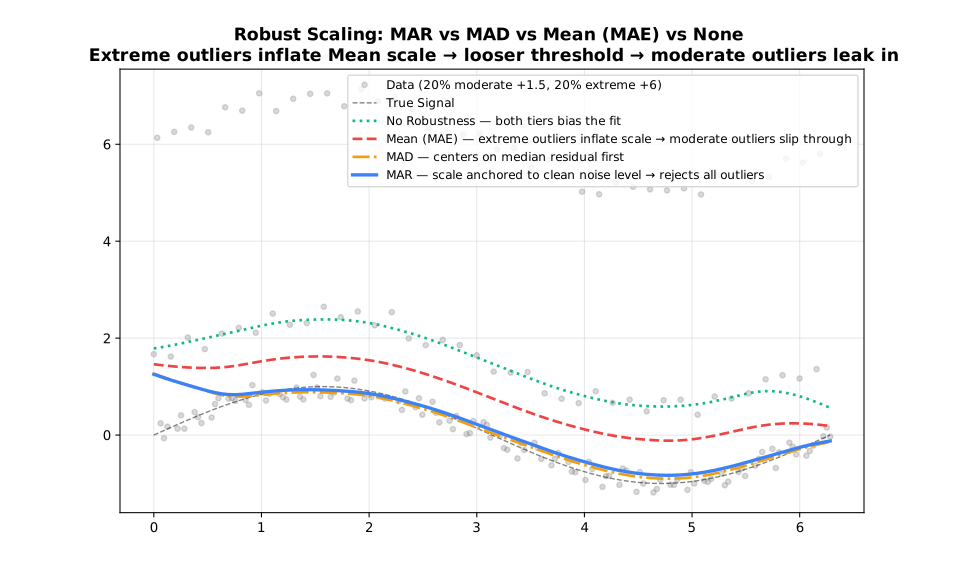
Residuals are scaled before computing robustness weights. Two methods:
| Method | Formula | Robustness |
|---|---|---|
| MAD | median(\|r − median(r)\|) |
Very robust (default) |
| MAR | median(\|r\|) |
Robust, uncentered |
| Mean | mean(\|r\|) |
Less robust, fastest |
use fastLowess::prelude::*;
use std::f64::consts::TAU;

fn main() -> Result<(), LowessError> {
    let n = 100usize;
    let x: Vec<f64> = (0..n).map(|i| i as f64 * TAU / (n - 1) as f64).collect();
    let y: Vec<f64> = x.iter().map(|&xi| xi.sin() + 0.1).collect();

    let model = Lowess::new()
        .iterations(3)
        .scaling_method("mad")  // Default
        .build()?;
    let result = model.fit(&x, &y)?;

    Ok(())
}
const { Lowess } = require('fastlowess');

const n = 100;
const x = Float64Array.from({ length: n }, (_, i) => i * 2 * Math.PI / (n - 1));
const y = Float64Array.from(x, (xi, i) => Math.sin(xi) + (((i * 7 + 3) % 17) / 17 - 0.5) * 0.6);

const model = new Lowess({ iterations: 3, scaling_method: "mad" });
const result = model.fit(x, y);
import init, { Lowess } from 'fastlowess-wasm';
await init();

const n = 100;
const x = Float64Array.from({ length: n }, (_, i) => i * 2 * Math.PI / (n - 1));
const y = Float64Array.from(x, (xi, i) => Math.sin(xi) + (((i * 7 + 3) % 17) / 17 - 0.5) * 0.6);

const model = new Lowess({ iterations: 3, scaling_method: "mad" });
const result = model.fit(x, y);
#include <fastlowess.hpp>
#include <cmath>
#include <iostream>
#include <vector>

int main() {
    const int n = 100;
    std::vector<double> x(n), y(n);
    for (int i = 0; i < n; ++i) {
        x[i] = i * 2 * M_PI / (n - 1);
        y[i] = std::sin(x[i]) + 0.1;
    }

    fastlowess::Lowess model({ .iterations = 3,
        .scaling_method = "mad"
     });
    auto result = model.fit(x, y).value();

    return 0;
}
Auto-Convergence
Stop iterations early when weights stabilize:
Performance
Auto-convergence can significantly reduce computation when weights stabilize before reaching max iterations.
use fastLowess::prelude::*;
use std::f64::consts::TAU;

fn main() -> Result<(), LowessError> {
    let n = 100usize;
    let x: Vec<f64> = (0..n).map(|i| i as f64 * TAU / (n - 1) as f64).collect();
    let y: Vec<f64> = x.iter().map(|&xi| xi.sin() + 0.1).collect();

    let model = Lowess::new()
        .iterations(10)           // Maximum iterations
        .auto_converge(1e-6)      // Stop when change < 1e-6
        .build()?;
    let result = model.fit(&x, &y)?;

    Ok(())
}
const { Lowess } = require('fastlowess');

const n = 100;
const x = Float64Array.from({ length: n }, (_, i) => i * 2 * Math.PI / (n - 1));
const y = Float64Array.from(x, (xi, i) => Math.sin(xi) + (((i * 7 + 3) % 17) / 17 - 0.5) * 0.6);

const model = new Lowess({ iterations: 10, auto_converge: 1e-6 });
const result = model.fit(x, y);
import init, { Lowess } from 'fastlowess-wasm';
await init();

const n = 100;
const x = Float64Array.from({ length: n }, (_, i) => i * 2 * Math.PI / (n - 1));
const y = Float64Array.from(x, (xi, i) => Math.sin(xi) + (((i * 7 + 3) % 17) / 17 - 0.5) * 0.6);

const model = new Lowess({ iterations: 10, auto_converge: 1e-6 });
const result = model.fit(x, y);
#include <fastlowess.hpp>
#include <cmath>
#include <iostream>
#include <vector>

int main() {
    const int n = 100;
    std::vector<double> x(n), y(n);
    for (int i = 0; i < n; ++i) {
        x[i] = i * 2 * M_PI / (n - 1);
        y[i] = std::sin(x[i]) + 0.1;
    }

    fastlowess::Lowess model({ .iterations = 10,
        .auto_converge = 1e-6
     });
    auto result = model.fit(x, y).value();

    return 0;
}