Weight Functions
Kernel functions for distance weighting.
Overview
Weight functions (kernels) determine how neighboring points contribute to each local fit. Points closer to the target receive higher weights.
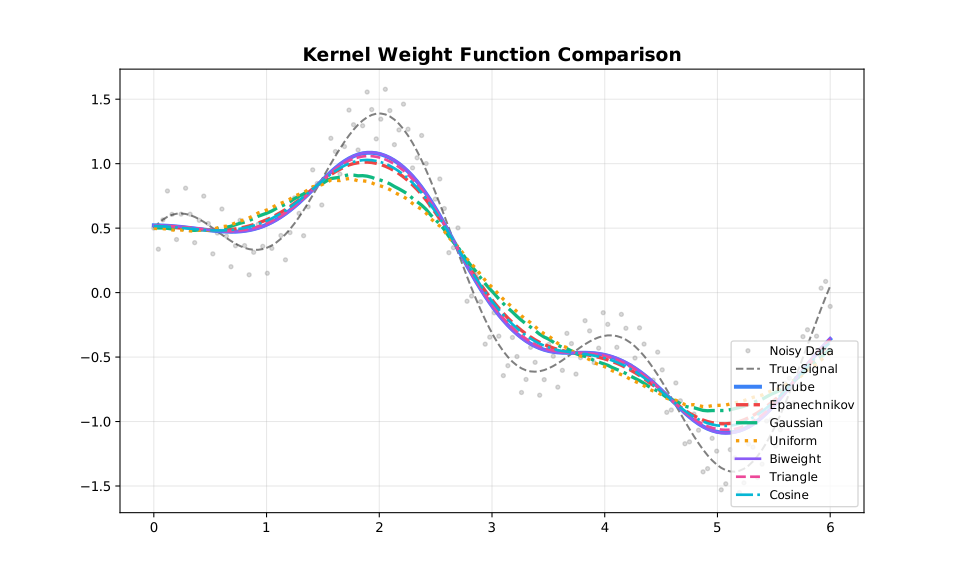
Available Kernels
| Kernel | Efficiency | Smoothness | Support |
|---|---|---|---|
| Tricube | 0.998 | Very smooth | Compact |
| Epanechnikov | 1.000 | Smooth | Compact |
| Gaussian | 0.961 | Infinite | Unbounded |
| Biweight | 0.995 | Very smooth | Compact |
| Cosine | 0.999 | Smooth | Compact |
| Triangle | 0.989 | Moderate | Compact |
| Uniform | 0.943 | None | Compact |
Efficiency = AMISE relative to Epanechnikov (1.0 = optimal)
Tricube (Default)
Cleveland's original choice. Best all-around performance.
Use when: Default choice for most applications.
use fastLowess::prelude::*;
use std::f64::consts::TAU;

fn main() -> Result<(), LowessError> {
    let n = 100usize;
    let x: Vec<f64> = (0..n).map(|i| i as f64 * TAU / (n - 1) as f64).collect();
    let y: Vec<f64> = x.iter().map(|&xi| xi.sin() + 0.1).collect();

    let model = Lowess::new()
        .weight_function("tricube")
        .build()?;
    let result = model.fit(&x, &y)?;

    Ok(())
}
const { Lowess } = require('fastlowess');

const n = 100;
const x = Float64Array.from({ length: n }, (_, i) => i * 2 * Math.PI / (n - 1));
const y = Float64Array.from(x, (xi, i) => Math.sin(xi) + (((i * 7 + 3) % 17) / 17 - 0.5) * 0.6);

const model = new Lowess({ weight_function: "tricube" });
const result = model.fit(x, y);
import init, { Lowess } from 'fastlowess-wasm';
await init();

const n = 100;
const x = Float64Array.from({ length: n }, (_, i) => i * 2 * Math.PI / (n - 1));
const y = Float64Array.from(x, (xi, i) => Math.sin(xi) + (((i * 7 + 3) % 17) / 17 - 0.5) * 0.6);

const model = new Lowess({ weight_function: "tricube" });
const result = model.fit(x, y);
#include <fastlowess.hpp>
#include <cmath>
#include <iostream>
#include <vector>

int main() {
    const int n = 100;
    std::vector<double> x(n), y(n);
    for (int i = 0; i < n; ++i) {
        x[i] = i * 2 * M_PI / (n - 1);
        y[i] = std::sin(x[i]) + 0.1;
    }

    fastlowess::Lowess model({ .weight_function = "tricube" });
    auto result = model.fit(x, y).value();

    return 0;
}
Epanechnikov
Theoretically optimal for kernel density estimation.
Use when: Optimal MSE properties desired.
use fastLowess::prelude::*;
use std::f64::consts::TAU;

fn main() -> Result<(), LowessError> {
    let n = 100usize;
    let x: Vec<f64> = (0..n).map(|i| i as f64 * TAU / (n - 1) as f64).collect();
    let y: Vec<f64> = x.iter().map(|&xi| xi.sin() + 0.1).collect();

    let model = Lowess::new()
        .weight_function("epanechnikov")
        .build()?;
    let result = model.fit(&x, &y)?;

    Ok(())
}
const { Lowess } = require('fastlowess');

const n = 100;
const x = Float64Array.from({ length: n }, (_, i) => i * 2 * Math.PI / (n - 1));
const y = Float64Array.from(x, (xi, i) => Math.sin(xi) + (((i * 7 + 3) % 17) / 17 - 0.5) * 0.6);

const model = new Lowess({ weight_function: "epanechnikov" });
const result = model.fit(x, y);
import init, { Lowess } from 'fastlowess-wasm';
await init();

const n = 100;
const x = Float64Array.from({ length: n }, (_, i) => i * 2 * Math.PI / (n - 1));
const y = Float64Array.from(x, (xi, i) => Math.sin(xi) + (((i * 7 + 3) % 17) / 17 - 0.5) * 0.6);

const model = new Lowess({ weight_function: "epanechnikov" });
const result = model.fit(x, y);
#include <fastlowess.hpp>
#include <cmath>
#include <iostream>
#include <vector>

int main() {
    const int n = 100;
    std::vector<double> x(n), y(n);
    for (int i = 0; i < n; ++i) {
        x[i] = i * 2 * M_PI / (n - 1);
        y[i] = std::sin(x[i]) + 0.1;
    }

    fastlowess::Lowess model({ .weight_function = "epanechnikov" });
    auto result = model.fit(x, y).value();

    return 0;
}
Gaussian
Infinitely smooth. No boundary effects.
Use when: Maximum smoothness needed, computational cost acceptable.
use fastLowess::prelude::*;
use std::f64::consts::TAU;

fn main() -> Result<(), LowessError> {
    let n = 100usize;
    let x: Vec<f64> = (0..n).map(|i| i as f64 * TAU / (n - 1) as f64).collect();
    let y: Vec<f64> = x.iter().map(|&xi| xi.sin() + 0.1).collect();

    let model = Lowess::new()
        .weight_function("gaussian")
        .build()?;
    let result = model.fit(&x, &y)?;

    Ok(())
}
const { Lowess } = require('fastlowess');

const n = 100;
const x = Float64Array.from({ length: n }, (_, i) => i * 2 * Math.PI / (n - 1));
const y = Float64Array.from(x, (xi, i) => Math.sin(xi) + (((i * 7 + 3) % 17) / 17 - 0.5) * 0.6);

const model = new Lowess({ weight_function: "gaussian" });
const result = model.fit(x, y);
import init, { Lowess } from 'fastlowess-wasm';
await init();

const n = 100;
const x = Float64Array.from({ length: n }, (_, i) => i * 2 * Math.PI / (n - 1));
const y = Float64Array.from(x, (xi, i) => Math.sin(xi) + (((i * 7 + 3) % 17) / 17 - 0.5) * 0.6);

const model = new Lowess({ weight_function: "gaussian" });
const result = model.fit(x, y);
#include <fastlowess.hpp>
#include <cmath>
#include <iostream>
#include <vector>

int main() {
    const int n = 100;
    std::vector<double> x(n), y(n);
    for (int i = 0; i < n; ++i) {
        x[i] = i * 2 * M_PI / (n - 1);
        y[i] = std::sin(x[i]) + 0.1;
    }

    fastlowess::Lowess model({ .weight_function = "gaussian" });
    auto result = model.fit(x, y).value();

    return 0;
}
Biweight
Good balance of efficiency and smoothness.
Use when: Alternative to Tricube with slightly different properties.
use fastLowess::prelude::*;
use std::f64::consts::TAU;

fn main() -> Result<(), LowessError> {
    let n = 100usize;
    let x: Vec<f64> = (0..n).map(|i| i as f64 * TAU / (n - 1) as f64).collect();
    let y: Vec<f64> = x.iter().map(|&xi| xi.sin() + 0.1).collect();

    let model = Lowess::new()
        .weight_function("biweight")
        .build()?;
    let result = model.fit(&x, &y)?;

    Ok(())
}
const { Lowess } = require('fastlowess');

const n = 100;
const x = Float64Array.from({ length: n }, (_, i) => i * 2 * Math.PI / (n - 1));
const y = Float64Array.from(x, (xi, i) => Math.sin(xi) + (((i * 7 + 3) % 17) / 17 - 0.5) * 0.6);

const model = new Lowess({ weight_function: "biweight" });
const result = model.fit(x, y);
import init, { Lowess } from 'fastlowess-wasm';
await init();

const n = 100;
const x = Float64Array.from({ length: n }, (_, i) => i * 2 * Math.PI / (n - 1));
const y = Float64Array.from(x, (xi, i) => Math.sin(xi) + (((i * 7 + 3) % 17) / 17 - 0.5) * 0.6);

const model = new Lowess({ weight_function: "biweight" });
const result = model.fit(x, y);
#include <fastlowess.hpp>
#include <cmath>
#include <iostream>
#include <vector>

int main() {
    const int n = 100;
    std::vector<double> x(n), y(n);
    for (int i = 0; i < n; ++i) {
        x[i] = i * 2 * M_PI / (n - 1);
        y[i] = std::sin(x[i]) + 0.1;
    }

    fastlowess::Lowess model({ .weight_function = "biweight" });
    auto result = model.fit(x, y).value();

    return 0;
}
Cosine
Smooth and computationally efficient.
Use when: Want smooth kernel with simple form.
use fastLowess::prelude::*;
use std::f64::consts::TAU;

fn main() -> Result<(), LowessError> {
    let n = 100usize;
    let x: Vec<f64> = (0..n).map(|i| i as f64 * TAU / (n - 1) as f64).collect();
    let y: Vec<f64> = x.iter().map(|&xi| xi.sin() + 0.1).collect();

    let model = Lowess::new()
        .weight_function("cosine")
        .build()?;
    let result = model.fit(&x, &y)?;

    Ok(())
}
const { Lowess } = require('fastlowess');

const n = 100;
const x = Float64Array.from({ length: n }, (_, i) => i * 2 * Math.PI / (n - 1));
const y = Float64Array.from(x, (xi, i) => Math.sin(xi) + (((i * 7 + 3) % 17) / 17 - 0.5) * 0.6);

const model = new Lowess({ weight_function: "cosine" });
const result = model.fit(x, y);
import init, { Lowess } from 'fastlowess-wasm';
await init();

const n = 100;
const x = Float64Array.from({ length: n }, (_, i) => i * 2 * Math.PI / (n - 1));
const y = Float64Array.from(x, (xi, i) => Math.sin(xi) + (((i * 7 + 3) % 17) / 17 - 0.5) * 0.6);

const model = new Lowess({ weight_function: "cosine" });
const result = model.fit(x, y);
#include <fastlowess.hpp>
#include <cmath>
#include <iostream>
#include <vector>

int main() {
    const int n = 100;
    std::vector<double> x(n), y(n);
    for (int i = 0; i < n; ++i) {
        x[i] = i * 2 * M_PI / (n - 1);
        y[i] = std::sin(x[i]) + 0.1;
    }

    fastlowess::Lowess model({ .weight_function = "cosine" });
    auto result = model.fit(x, y).value();

    return 0;
}
Triangle
Simple linear taper.
Use when: Simple, interpretable weights.
use fastLowess::prelude::*;
use std::f64::consts::TAU;

fn main() -> Result<(), LowessError> {
    let n = 100usize;
    let x: Vec<f64> = (0..n).map(|i| i as f64 * TAU / (n - 1) as f64).collect();
    let y: Vec<f64> = x.iter().map(|&xi| xi.sin() + 0.1).collect();

    let model = Lowess::new()
        .weight_function("triangle")
        .build()?;
    let result = model.fit(&x, &y)?;

    Ok(())
}
const { Lowess } = require('fastlowess');

const n = 100;
const x = Float64Array.from({ length: n }, (_, i) => i * 2 * Math.PI / (n - 1));
const y = Float64Array.from(x, (xi, i) => Math.sin(xi) + (((i * 7 + 3) % 17) / 17 - 0.5) * 0.6);

const model = new Lowess({ weight_function: "triangle" });
const result = model.fit(x, y);
import init, { Lowess } from 'fastlowess-wasm';
await init();

const n = 100;
const x = Float64Array.from({ length: n }, (_, i) => i * 2 * Math.PI / (n - 1));
const y = Float64Array.from(x, (xi, i) => Math.sin(xi) + (((i * 7 + 3) % 17) / 17 - 0.5) * 0.6);

const model = new Lowess({ weight_function: "triangle" });
const result = model.fit(x, y);
#include <fastlowess.hpp>
#include <cmath>
#include <iostream>
#include <vector>

int main() {
    const int n = 100;
    std::vector<double> x(n), y(n);
    for (int i = 0; i < n; ++i) {
        x[i] = i * 2 * M_PI / (n - 1);
        y[i] = std::sin(x[i]) + 0.1;
    }

    fastlowess::Lowess model({ .weight_function = "triangle" });
    auto result = model.fit(x, y).value();

    return 0;
}
Uniform
Equal weights within window. Fastest but least smooth.
Use when: Speed is critical, smoothness less important.
use fastLowess::prelude::*;
use std::f64::consts::TAU;

fn main() -> Result<(), LowessError> {
    let n = 100usize;
    let x: Vec<f64> = (0..n).map(|i| i as f64 * TAU / (n - 1) as f64).collect();
    let y: Vec<f64> = x.iter().map(|&xi| xi.sin() + 0.1).collect();

    let model = Lowess::new()
        .weight_function("uniform")
        .build()?;
    let result = model.fit(&x, &y)?;

    Ok(())
}
const { Lowess } = require('fastlowess');

const n = 100;
const x = Float64Array.from({ length: n }, (_, i) => i * 2 * Math.PI / (n - 1));
const y = Float64Array.from(x, (xi, i) => Math.sin(xi) + (((i * 7 + 3) % 17) / 17 - 0.5) * 0.6);

const model = new Lowess({ weight_function: "uniform" });
const result = model.fit(x, y);
import init, { Lowess } from 'fastlowess-wasm';
await init();

const n = 100;
const x = Float64Array.from({ length: n }, (_, i) => i * 2 * Math.PI / (n - 1));
const y = Float64Array.from(x, (xi, i) => Math.sin(xi) + (((i * 7 + 3) % 17) / 17 - 0.5) * 0.6);

const model = new Lowess({ weight_function: "uniform" });
const result = model.fit(x, y);
#include <fastlowess.hpp>
#include <cmath>
#include <iostream>
#include <vector>

int main() {
    const int n = 100;
    std::vector<double> x(n), y(n);
    for (int i = 0; i < n; ++i) {
        x[i] = i * 2 * M_PI / (n - 1);
        y[i] = std::sin(x[i]) + 0.1;
    }

    fastlowess::Lowess model({ .weight_function = "uniform" });
    auto result = model.fit(x, y).value();

    return 0;
}
Choosing a Kernel
Recommendation
Stick with Tricube (default) unless you have specific requirements. The differences between kernels are usually small in practice.