LOWESS Project
The fastest, most robust, and most feature-complete language-agnostic LOWESS (Locally Weighted Scatterplot Smoothing) implementation for Rust, Python, R, Julia, JavaScript, C++, and WebAssembly.
What is LOWESS?
LOWESS is a nonparametric regression method that fits smooth curves through scatter plots. At each point, it fits a weighted polynomial using nearby data, with weights decreasing smoothly with distance. This creates flexible, data-adaptive curves without assuming a global functional form.
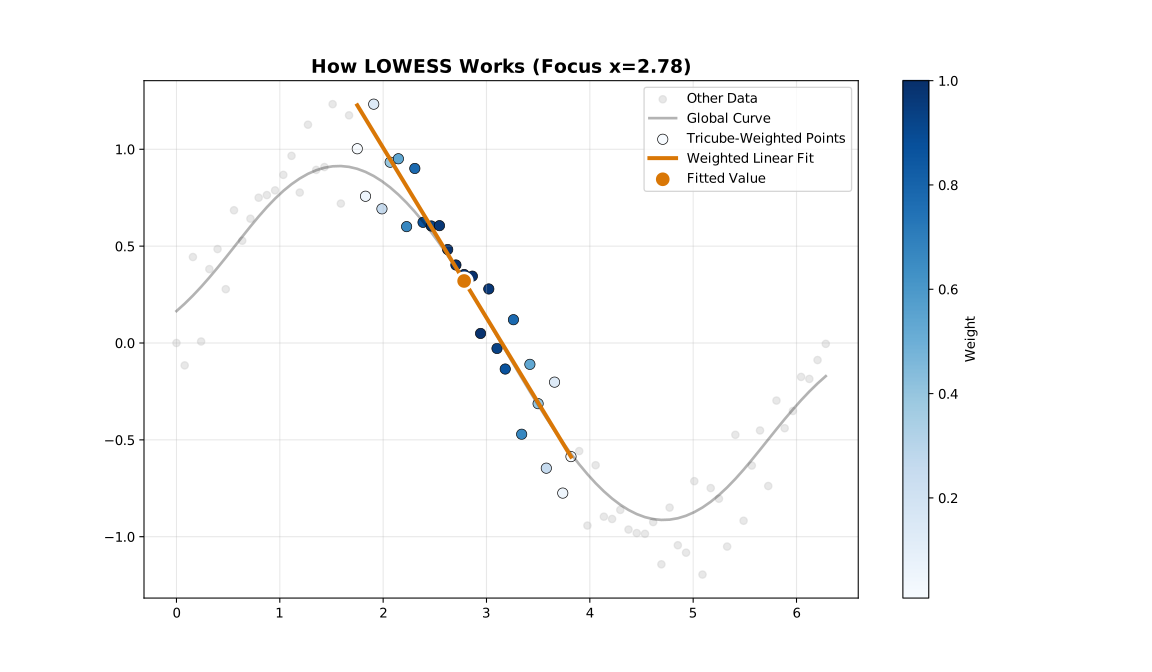
Key advantages:
- No parametric assumptions — Adapts to local data structure
- Robust to outliers — With robustness iterations enabled
- Uncertainty quantification — Confidence and prediction intervals
- Handles irregular sampling — Works with missing regions gracefully
Why this package?
Speed
The lowess project beats the competition in terms of speed, whether in single-threaded or multi-threaded parallel execution.
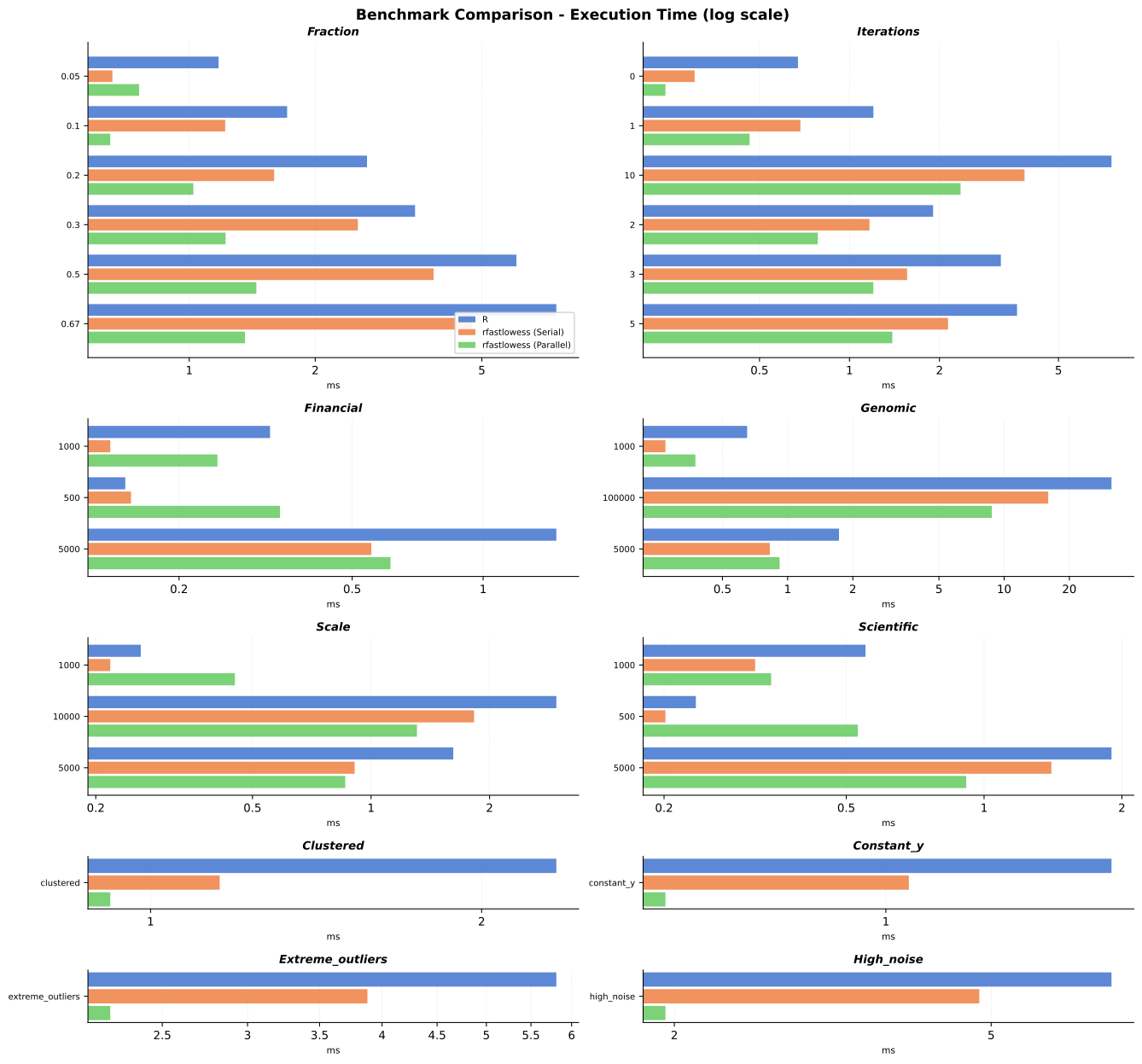
For detailed benchmark comparisons, see the Benchmarks page.
Robustness
This implementation is more robust than R's lowess and Python's statsmodels due to two key design choices:
MAD-Based Scale Estimation:
For robustness weight calculations, this crate uses Median Absolute Deviation (MAD) for scale estimation:
In contrast, statsmodels and R's lowess uses the median of absolute residuals (MAR):
- MAD is a breakdown-point-optimal estimator—it remains valid even when up to 50% of data are outliers.
- The median-centering step removes asymmetric bias from residual distributions.
- MAD provides consistent outlier detection regardless of whether residuals are centered around zero.
Boundary Padding:
This crate applies a range of different boundary policies at dataset edges:
- Extend: Repeats edge values to maintain local neighborhood size.
- Reflect: Mirrors data symmetrically around boundaries.
- Zero: Pads with zeros (useful for signal processing).
- NoBoundary: Original Cleveland behavior
statsmodels and R's lowess do not apply boundary padding, which can lead to:
- Biased estimates near boundaries due to asymmetric local neighborhoods.
- Increased variance at the edges of the smoothed curve.
Features
A variety of features, supporting a range of use cases:
| Feature | This package | statsmodels | R (stats) |
|---|---|---|---|
| Kernel | 7 options | only Tricube | only Tricube |
| Robustness Weighting | 3 options | only Huber | only Huber |
| Scale Estimation | 3 options | only MAR | only MAR |
| Boundary Padding | 4 options | no padding | no padding |
| Zero Weight Fallback | 3 options | no | no |
| Auto Convergence | yes | no | no |
| Online Mode | yes | no | no |
| Streaming Mode | yes | no | no |
| Confidence Intervals | yes | no | no |
| Prediction Intervals | yes | no | no |
| Cross-Validation | 2 options | no | no |
| Parallel Execution | yes | no | no |
| GPU Acceleration | yes* | no | no |
no-std Support |
yes | no | no |
* GPU acceleration is currently in beta and may not be available on all platforms.
Installation
Currently available for R, Python, Rust, Julia, Node.js, and WebAssembly.
From R-universe (recommended, no Rust toolchain required):
Or from conda-forge:
Install from PyPI:
Or from conda-forge:
Install from npm:
Or via CDN:
See the Installation Guide for more options and details.
Quick Example
use lowess::prelude::*;
use std::f64::consts::TAU;

fn main() -> Result<(), LowessError> {
    let n = 100usize;
    let x: Vec<f64> = (0..n).map(|i| i as f64 * TAU / (n - 1) as f64).collect();
    let y: Vec<f64> = x.iter().map(|&xi| xi.sin() + 0.1).collect();


    let x = vec![1.0, 2.0, 3.0, 4.0, 5.0];
    let y = vec![2.0, 4.1, 5.9, 8.2, 9.8];

    let model = Lowess::new()
        .fraction(0.5)
        .iterations(3)
        .build()?;

    let result = model.fit(&x, &y)?;
    println!("{}", result);

    Ok(())
}
#include <fastlowess.hpp>
#include <iostream>
#include <vector>

int main() {
    std::vector<double> x = {1.0, 2.0, 3.0, 4.0, 5.0};
    std::vector<double> y = {2.0, 4.1, 5.9, 8.2, 9.8};

    fastlowess::LowessOptions options;
    options.fraction = 0.5;
    options.iterations = 3;

    fastlowess::Lowess model(options);
    auto result = model.fit(x, y).value();

    for (const auto& val : result.y_vector()) {
        std::cout << val << " ";
    }
    std::cout << std::endl;
    return 0;
}
Getting Started
- Installation — Set up the library for your language
- Quick Start — Basic usage examples
- Concepts — Understand how LOWESS works
-
Rust
Pure Rust crates with zero-copy ndarray support, parallel execution, and GPU acceleration.
-
Python
Native Python bindings via PyO3 with NumPy integration and pip installation.
-
R
R package with Bioconductor-style documentation and seamless integration.
-
Julia
Native Julia package with C FFI, supporting parallel execution and JLL dependencies.
-
Node.js
Native Node.js bindings with high-performance C++ core and support for asynchronous streaming.
-
WebAssembly
Optimized WebAssembly build for browsers and Node.js with zero-overhead data transfer.
-
C++
Native C++ bindings with RAII memory management and STL container support.
License
Dual-licensed under MIT or Apache-2.0.