Parameters
Complete reference for all LOWESS configuration options.
Quick Reference
Language-specific values
Null value — R: NULL · Python: None · Rust: None · Julia: nothing · Node.js/WASM: null · C++: NAN (floats), 0 (integers), {} (vectors)
Logical false — R uses FALSE, Python uses False, and Rust, Julia, Node.js, WASM, and C++ use false.
| Parameter | Default | Range/Options | Description | Adapter |
|---|---|---|---|---|
| fraction | 0.67 | (0, 1] | Smoothing span | All |
| iterations | 3 | [0, 1000] | Robustness iterations | All |
| delta | Null value | [0, ∞) | Interpolation threshold | All |
| weight_function | "tricube" |
7 options | Distance kernel | All |
| robustness_method | "bisquare" |
3 options | Outlier weighting | All |
| zero_weight_fallback | "use_local_mean" |
3 options | Zero-weight behavior | All |
| boundary_policy | "extend" |
4 options | Edge handling | All |
| scaling_method | "mad" |
3 options | Scale estimation | All |
| auto_converge | Null value | tolerance | Early stopping | All |
| return_residuals | Logical false | logical | Include residuals | All |
| return_robustness_weights | Logical false | logical | Include weights | All |
| return_se | Logical false | logical | Return standard errors | All |
| return_diagnostics | Logical false | logical | Include metrics | Batch, Streaming |
| custom_weights | Null value | positive | Per-observation weights | Batch |
| confidence_intervals | Null value | (0, 1) | CI level | Batch |
| prediction_intervals | Null value | (0, 1) | PI level | Batch |
| cv_method | Null value | method | Auto-select fraction | Batch |
| chunk_size | 5000 | [10, ∞) | Points per chunk | Streaming |
| overlap | 500 | [0, chunk) | Overlap between chunks | Streaming |
| merge_strategy | "weighted_average" |
4 options | Merge overlaps | Streaming |
| window_capacity | 1000 | [3, ∞) | Max window size | Online |
| min_points | 2 | [2, window] | Min before output | Online |
| update_mode | "incremental" |
2 options | Update strategy | Online |
Rust option values
In Rust, pass option-like parameters as strings (case-insensitive), e.g. "tricube", "bisquare", "extend", "average".
Parameter Options Summary
| Parameter | Available Options |
|---|---|
| weight_function | "tricube", "epanechnikov", "gaussian", "biweight", "cosine", "triangle", "uniform" |
| robustness_method | "bisquare", "huber", "talwar" |
| zero_weight_fallback | "use_local_mean", "return_original", "return_none" |
| boundary_policy | "extend", "reflect", "zero", "noboundary" |
| scaling_method | "mad", "mar", "mean" |
| merge_strategy | "average", "weighted_average", "take_first", "take_last" |
| update_mode | "incremental", "full" |
Core Parameters
fraction
The proportion of data used for each local fit. Most important parameter.
| Value | Effect | Use Case |
|---|---|---|
| 0.1–0.3 | Fine detail | Rapidly changing signals |
| 0.3–0.5 | Balanced | General purpose |
| 0.5–0.7 | Heavy smoothing | Noisy data |
| 0.7–1.0 | Very smooth | Trend extraction |
use fastLowess::prelude::*;
use std::f64::consts::TAU;

fn main() -> Result<(), LowessError> {
    let n = 100usize;
    let x: Vec<f64> = (0..n).map(|i| i as f64 * TAU / (n - 1) as f64).collect();
    let y: Vec<f64> = x.iter().map(|&xi| xi.sin() + 0.1).collect();

    let model = Lowess::new()
        .fraction(0.3)
        .build()?;
    let result = model.fit(&x, &y)?;

    Ok(())
}
const { Lowess } = require('fastlowess');

const n = 100;
const x = Float64Array.from({ length: n }, (_, i) => i * 2 * Math.PI / (n - 1));
const y = Float64Array.from(x, (xi, i) => Math.sin(xi) + (((i * 7 + 3) % 17) / 17 - 0.5) * 0.6);

const model = new Lowess({fraction: 0.3});
const result = model.fit(x, y);
import init, { Lowess } from 'fastlowess-wasm';
await init();

const n = 100;
const x = Float64Array.from({ length: n }, (_, i) => i * 2 * Math.PI / (n - 1));
const y = Float64Array.from(x, (xi, i) => Math.sin(xi) + (((i * 7 + 3) % 17) / 17 - 0.5) * 0.6);

const model = new Lowess({fraction: 0.3});
const result = model.fit(x, y);
#include <fastlowess.hpp>
#include <cmath>
#include <iostream>
#include <vector>

int main() {
    const int n = 100;
    std::vector<double> x(n), y(n);
    for (int i = 0; i < n; ++i) {
        x[i] = i * 2 * M_PI / (n - 1);
        y[i] = std::sin(x[i]) + 0.1;
    }

    fastlowess::Lowess model({ .fraction = 0.3});
    auto result = model.fit(x, y).value();

    return 0;
}
iterations
Number of robustness iterations for outlier resistance.
| Value | Effect | Performance |
|---|---|---|
| 0 | No robustness | Fastest |
| 1–3 | Moderate | Recommended |
| 4–6 | Strong | Contaminated data |
| 7+ | Very strong | Heavy outliers |
use fastLowess::prelude::*;
use std::f64::consts::TAU;

fn main() -> Result<(), LowessError> {
    let n = 100usize;
    let x: Vec<f64> = (0..n).map(|i| i as f64 * TAU / (n - 1) as f64).collect();
    let y: Vec<f64> = x.iter().map(|&xi| xi.sin() + 0.1).collect();

    let model = Lowess::new()
        .iterations(5)
        .build()?;
    let result = model.fit(&x, &y)?;

    Ok(())
}
const { Lowess } = require('fastlowess');

const n = 100;
const x = Float64Array.from({ length: n }, (_, i) => i * 2 * Math.PI / (n - 1));
const y = Float64Array.from(x, (xi, i) => Math.sin(xi) + (((i * 7 + 3) % 17) / 17 - 0.5) * 0.6);

const model = new Lowess({iterations: 5});
const result = model.fit(x, y);
import init, { Lowess } from 'fastlowess-wasm';
await init();

const n = 100;
const x = Float64Array.from({ length: n }, (_, i) => i * 2 * Math.PI / (n - 1));
const y = Float64Array.from(x, (xi, i) => Math.sin(xi) + (((i * 7 + 3) % 17) / 17 - 0.5) * 0.6);

const model = new Lowess({iterations: 5});
const result = model.fit(x, y);
#include <fastlowess.hpp>
#include <cmath>
#include <iostream>
#include <vector>

int main() {
    const int n = 100;
    std::vector<double> x(n), y(n);
    for (int i = 0; i < n; ++i) {
        x[i] = i * 2 * M_PI / (n - 1);
        y[i] = std::sin(x[i]) + 0.1;
    }

    fastlowess::Lowess model({ .iterations = 5});
    auto result = model.fit(x, y).value();

    return 0;
}
delta
Interpolation optimization threshold. Points within delta distance reuse the previous fit.
- Default: 1% of x-range (Batch), 0.0 (Streaming/Online)
- Effect: Higher values = faster but less accurate
use fastLowess::prelude::*;
use std::f64::consts::TAU;

fn main() -> Result<(), LowessError> {
    let n = 100usize;
    let x: Vec<f64> = (0..n).map(|i| i as f64 * TAU / (n - 1) as f64).collect();
    let y: Vec<f64> = x.iter().map(|&xi| xi.sin() + 0.1).collect();

    let model = Lowess::new()
        .delta(0.05)
        .build()?;
    let result = model.fit(&x, &y)?;

    Ok(())
}
const { Lowess } = require('fastlowess');

const n = 100;
const x = Float64Array.from({ length: n }, (_, i) => i * 2 * Math.PI / (n - 1));
const y = Float64Array.from(x, (xi, i) => Math.sin(xi) + (((i * 7 + 3) % 17) / 17 - 0.5) * 0.6);

const model = new Lowess({delta: 0.05});
const result = model.fit(x, y);
import init, { Lowess } from 'fastlowess-wasm';
await init();

const n = 100;
const x = Float64Array.from({ length: n }, (_, i) => i * 2 * Math.PI / (n - 1));
const y = Float64Array.from(x, (xi, i) => Math.sin(xi) + (((i * 7 + 3) % 17) / 17 - 0.5) * 0.6);

const model = new Lowess({delta: 0.05});
const result = model.fit(x, y);
#include <fastlowess.hpp>
#include <cmath>
#include <iostream>
#include <vector>

int main() {
    const int n = 100;
    std::vector<double> x(n), y(n);
    for (int i = 0; i < n; ++i) {
        x[i] = i * 2 * M_PI / (n - 1);
        y[i] = std::sin(x[i]) + 0.1;
    }

    fastlowess::Lowess model({ .delta = 0.05});
    auto result = model.fit(x, y).value();

    return 0;
}
weight_function
Distance weighting kernel for local fits.
| Kernel | Efficiency | Smoothness |
|---|---|---|
"tricube" |
0.998 | Very smooth |
"epanechnikov" |
1.000 | Smooth |
"gaussian" |
0.961 | Infinite |
"biweight" |
0.995 | Very smooth |
"cosine" |
0.999 | Smooth |
"triangle" |
0.989 | Moderate |
"uniform" |
0.943 | None |
See Weight Functions for detailed comparison.
use fastLowess::prelude::*;
use std::f64::consts::TAU;

fn main() -> Result<(), LowessError> {
    let n = 100usize;
    let x: Vec<f64> = (0..n).map(|i| i as f64 * TAU / (n - 1) as f64).collect();
    let y: Vec<f64> = x.iter().map(|&xi| xi.sin() + 0.1).collect();

    let model = Lowess::new()
        .weight_function("epanechnikov")
        .build()?;
    let result = model.fit(&x, &y)?;

    Ok(())
}
const { Lowess } = require('fastlowess');

const n = 100;
const x = Float64Array.from({ length: n }, (_, i) => i * 2 * Math.PI / (n - 1));
const y = Float64Array.from(x, (xi, i) => Math.sin(xi) + (((i * 7 + 3) % 17) / 17 - 0.5) * 0.6);

const model = new Lowess({weight_function: "epanechnikov"});
const result = model.fit(x, y);
import init, { Lowess } from 'fastlowess-wasm';
await init();

const n = 100;
const x = Float64Array.from({ length: n }, (_, i) => i * 2 * Math.PI / (n - 1));
const y = Float64Array.from(x, (xi, i) => Math.sin(xi) + (((i * 7 + 3) % 17) / 17 - 0.5) * 0.6);

const model = new Lowess({weight_function: "epanechnikov"});
const result = model.fit(x, y);
#include <fastlowess.hpp>
#include <cmath>
#include <iostream>
#include <vector>

int main() {
    const int n = 100;
    std::vector<double> x(n), y(n);
    for (int i = 0; i < n; ++i) {
        x[i] = i * 2 * M_PI / (n - 1);
        y[i] = std::sin(x[i]) + 0.1;
    }

    fastlowess::Lowess model({ .weight_function = "epanechnikov"});
    auto result = model.fit(x, y).value();

    return 0;
}
robustness_method
Method for downweighting outliers during iterative refinement.
| Method | Behavior | Use Case |
|---|---|---|
"bisquare" |
Smooth downweighting | General-purpose |
"huber" |
Linear beyond threshold | Moderate outliers |
"talwar" |
Hard threshold (0 or 1) | Extreme contamination |
See Robustness for detailed comparison.
use fastLowess::prelude::*;
use std::f64::consts::TAU;

fn main() -> Result<(), LowessError> {
    let n = 100usize;
    let x: Vec<f64> = (0..n).map(|i| i as f64 * TAU / (n - 1) as f64).collect();
    let y: Vec<f64> = x.iter().map(|&xi| xi.sin() + 0.1).collect();

    let model = Lowess::new()
        .robustness_method("talwar")
        .build()?;
    let result = model.fit(&x, &y)?;

    Ok(())
}
const { Lowess } = require('fastlowess');

const n = 100;
const x = Float64Array.from({ length: n }, (_, i) => i * 2 * Math.PI / (n - 1));
const y = Float64Array.from(x, (xi, i) => Math.sin(xi) + (((i * 7 + 3) % 17) / 17 - 0.5) * 0.6);

const model = new Lowess({robustness_method: "talwar"});
const result = model.fit(x, y);
import init, { Lowess } from 'fastlowess-wasm';
await init();

const n = 100;
const x = Float64Array.from({ length: n }, (_, i) => i * 2 * Math.PI / (n - 1));
const y = Float64Array.from(x, (xi, i) => Math.sin(xi) + (((i * 7 + 3) % 17) / 17 - 0.5) * 0.6);

const model = new Lowess({robustness_method: "talwar"});
const result = model.fit(x, y);
#include <fastlowess.hpp>
#include <cmath>
#include <iostream>
#include <vector>

int main() {
    const int n = 100;
    std::vector<double> x(n), y(n);
    for (int i = 0; i < n; ++i) {
        x[i] = i * 2 * M_PI / (n - 1);
        y[i] = std::sin(x[i]) + 0.1;
    }

    fastlowess::Lowess model({ .robustness_method = "talwar"});
    auto result = model.fit(x, y).value();

    return 0;
}
boundary_policy
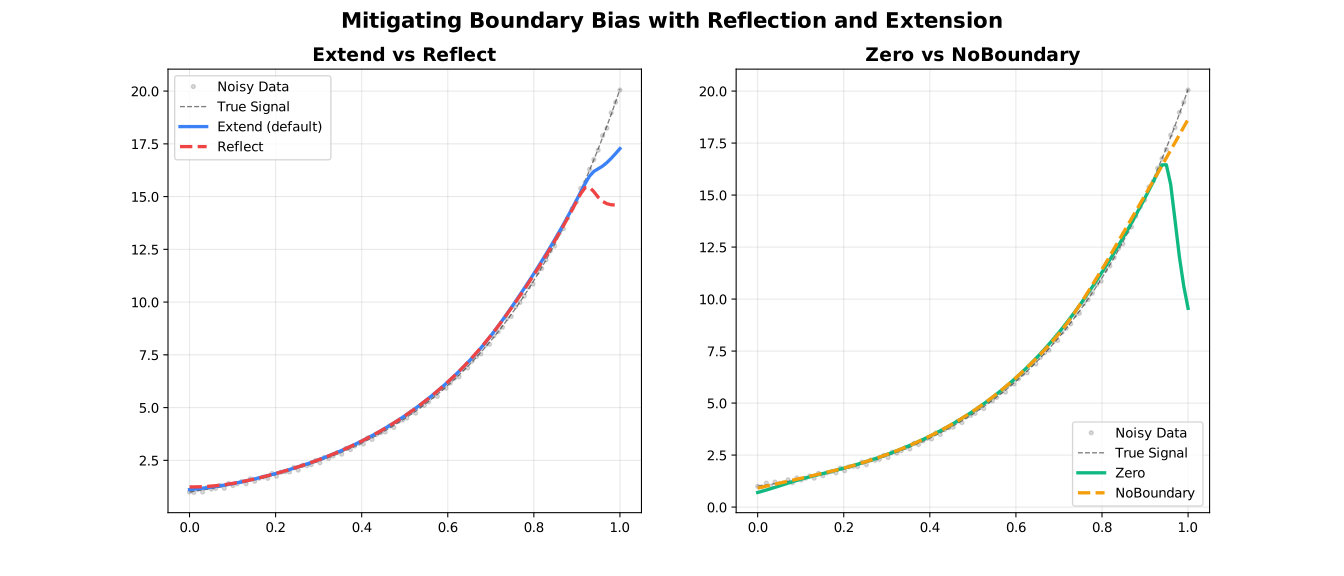
Edge handling strategy to reduce boundary bias. See Boundary Handling for a detailed comparison.
| Policy | Behavior | Use Case |
|---|---|---|
"extend" |
Pad with first/last values | Most cases (default) |
"reflect" |
Mirror data at boundaries | Periodic/symmetric data |
"zero" |
Pad with zeros | Data approaches zero |
"noboundary" |
No padding | Original Cleveland behavior |
For example:
use fastLowess::prelude::*;
use std::f64::consts::TAU;

fn main() -> Result<(), LowessError> {
    let n = 100usize;
    let x: Vec<f64> = (0..n).map(|i| i as f64 * TAU / (n - 1) as f64).collect();
    let y: Vec<f64> = x.iter().map(|&xi| xi.sin() + 0.1).collect();

    let model = Lowess::new()
        .boundary_policy("reflect")
        .build()?;
    let result = model.fit(&x, &y)?;

    Ok(())
}
const { Lowess } = require('fastlowess');

const n = 100;
const x = Float64Array.from({ length: n }, (_, i) => i * 2 * Math.PI / (n - 1));
const y = Float64Array.from(x, (xi, i) => Math.sin(xi) + (((i * 7 + 3) % 17) / 17 - 0.5) * 0.6);

const model = new Lowess({boundary_policy: "reflect"});
const result = model.fit(x, y);
import init, { Lowess } from 'fastlowess-wasm';
await init();

const n = 100;
const x = Float64Array.from({ length: n }, (_, i) => i * 2 * Math.PI / (n - 1));
const y = Float64Array.from(x, (xi, i) => Math.sin(xi) + (((i * 7 + 3) % 17) / 17 - 0.5) * 0.6);

const model = new Lowess({boundary_policy: "reflect"});
const result = model.fit(x, y);
#include <fastlowess.hpp>
#include <cmath>
#include <iostream>
#include <vector>

int main() {
    const int n = 100;
    std::vector<double> x(n), y(n);
    for (int i = 0; i < n; ++i) {
        x[i] = i * 2 * M_PI / (n - 1);
        y[i] = std::sin(x[i]) + 0.1;
    }

    fastlowess::Lowess model({ .boundary_policy = "reflect"});
    auto result = model.fit(x, y).value();

    return 0;
}
scaling_method
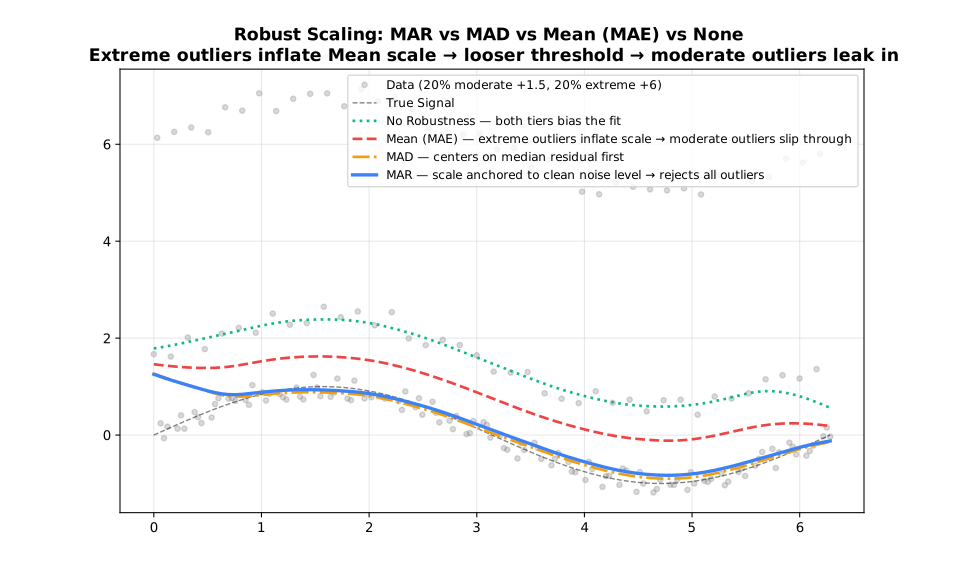
Method for estimating residual scale during robustness iterations. See Scaling Methods for a detailed comparison.
| Method | Description | Robustness |
|---|---|---|
"mad" |
Median Absolute Deviation | Very robust |
"mar" |
Median Absolute Residual | Robust |
"mean" |
Mean Absolute Residual | Less robust |
For example:
use fastLowess::prelude::*;
use std::f64::consts::TAU;

fn main() -> Result<(), LowessError> {
    let n = 100usize;
    let x: Vec<f64> = (0..n).map(|i| i as f64 * TAU / (n - 1) as f64).collect();
    let y: Vec<f64> = x.iter().map(|&xi| xi.sin() + 0.1).collect();

    let model = Lowess::new()
        .scaling_method("mad")
        .build()?;
    let result = model.fit(&x, &y)?;

    Ok(())
}
const { Lowess } = require('fastlowess');

const n = 100;
const x = Float64Array.from({ length: n }, (_, i) => i * 2 * Math.PI / (n - 1));
const y = Float64Array.from(x, (xi, i) => Math.sin(xi) + (((i * 7 + 3) % 17) / 17 - 0.5) * 0.6);

const model = new Lowess({scaling_method: "mad"});
const result = model.fit(x, y);
import init, { Lowess } from 'fastlowess-wasm';
await init();

const n = 100;
const x = Float64Array.from({ length: n }, (_, i) => i * 2 * Math.PI / (n - 1));
const y = Float64Array.from(x, (xi, i) => Math.sin(xi) + (((i * 7 + 3) % 17) / 17 - 0.5) * 0.6);

const model = new Lowess({scaling_method: "mad"});
const result = model.fit(x, y);
#include <fastlowess.hpp>
#include <cmath>
#include <iostream>
#include <vector>

int main() {
    const int n = 100;
    std::vector<double> x(n), y(n);
    for (int i = 0; i < n; ++i) {
        x[i] = i * 2 * M_PI / (n - 1);
        y[i] = std::sin(x[i]) + 0.1;
    }

    fastlowess::Lowess model({ .scaling_method = "mad"});
    auto result = model.fit(x, y).value();

    return 0;
}
zero_weight_fallback
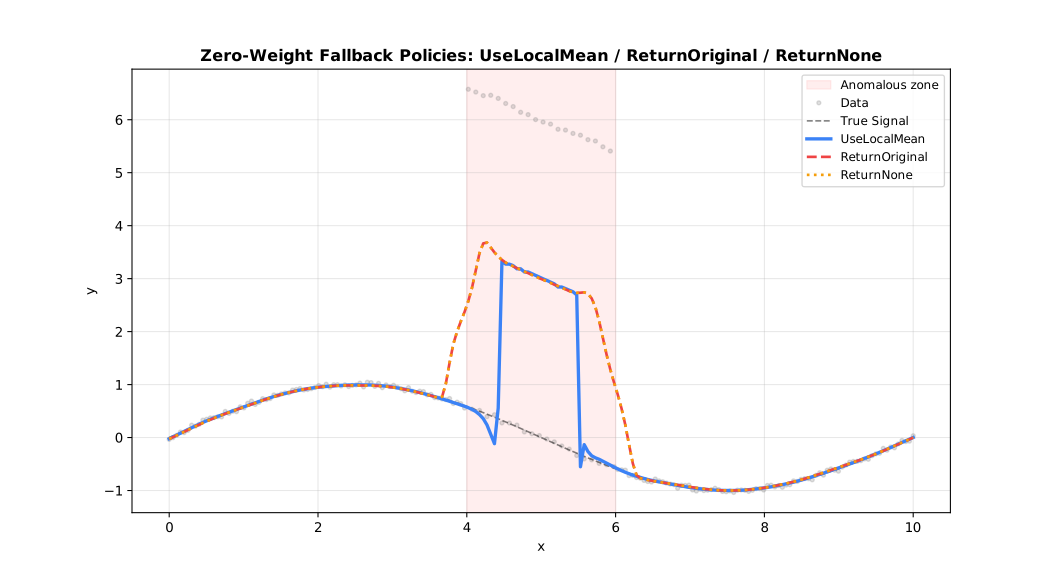
Behavior when all neighborhood weights are zero.
| Option | Behavior |
|---|---|
"use_local_mean" |
Use mean of neighborhood (default) |
"return_original" |
Return original y value |
"return_none" |
Return NaN |
For example:
use fastLowess::prelude::*;
use std::f64::consts::TAU;

fn main() -> Result<(), LowessError> {
    let n = 100usize;
    let x: Vec<f64> = (0..n).map(|i| i as f64 * TAU / (n - 1) as f64).collect();
    let y: Vec<f64> = x.iter().map(|&xi| xi.sin() + 0.1).collect();

    let model = Lowess::new()
        .zero_weight_fallback("use_local_mean")
        .build()?;
    let result = model.fit(&x, &y)?;

    Ok(())
}
const { Lowess } = require('fastlowess');

const n = 100;
const x = Float64Array.from({ length: n }, (_, i) => i * 2 * Math.PI / (n - 1));
const y = Float64Array.from(x, (xi, i) => Math.sin(xi) + (((i * 7 + 3) % 17) / 17 - 0.5) * 0.6);

const model = new Lowess({zero_weight_fallback: "use_local_mean"});
const result = model.fit(x, y);
import init, { Lowess } from 'fastlowess-wasm';
await init();

const n = 100;
const x = Float64Array.from({ length: n }, (_, i) => i * 2 * Math.PI / (n - 1));
const y = Float64Array.from(x, (xi, i) => Math.sin(xi) + (((i * 7 + 3) % 17) / 17 - 0.5) * 0.6);

const model = new Lowess({zero_weight_fallback: "use_local_mean"});
const result = model.fit(x, y);
#include <fastlowess.hpp>
#include <cmath>
#include <iostream>
#include <vector>

int main() {
    const int n = 100;
    std::vector<double> x(n), y(n);
    for (int i = 0; i < n; ++i) {
        x[i] = i * 2 * M_PI / (n - 1);
        y[i] = std::sin(x[i]) + 0.1;
    }

    fastlowess::Lowess model({ .zero_weight_fallback = "use_local_mean"});
    auto result = model.fit(x, y).value();

    return 0;
}
auto_converge
Enable early stopping when robustness weights stabilize.
use fastLowess::prelude::*;
use std::f64::consts::TAU;

fn main() -> Result<(), LowessError> {
    let n = 100usize;
    let x: Vec<f64> = (0..n).map(|i| i as f64 * TAU / (n - 1) as f64).collect();
    let y: Vec<f64> = x.iter().map(|&xi| xi.sin() + 0.1).collect();

    let model = Lowess::new()
        .iterations(20)           // Maximum
        .auto_converge(1e-6)      // Stop when change < 1e-6
        .build()?;
    let result = model.fit(&x, &y)?;

    Ok(())
}
const { Lowess } = require('fastlowess');

const n = 100;
const x = Float64Array.from({ length: n }, (_, i) => i * 2 * Math.PI / (n - 1));
const y = Float64Array.from(x, (xi, i) => Math.sin(xi) + (((i * 7 + 3) % 17) / 17 - 0.5) * 0.6);

const model = new Lowess({iterations: 20, auto_converge: 1e-6});
const result = model.fit(x, y);
import init, { Lowess } from 'fastlowess-wasm';
await init();

const n = 100;
const x = Float64Array.from({ length: n }, (_, i) => i * 2 * Math.PI / (n - 1));
const y = Float64Array.from(x, (xi, i) => Math.sin(xi) + (((i * 7 + 3) % 17) / 17 - 0.5) * 0.6);

const model = new Lowess({iterations: 20, auto_converge: 1e-6});
const result = model.fit(x, y);
#include <fastlowess.hpp>
#include <cmath>
#include <iostream>
#include <vector>

int main() {
    const int n = 100;
    std::vector<double> x(n), y(n);
    for (int i = 0; i < n; ++i) {
        x[i] = i * 2 * M_PI / (n - 1);
        y[i] = std::sin(x[i]) + 0.1;
    }

    fastlowess::Lowess model({ .iterations = 20, .auto_converge = 1e-6});
    auto result = model.fit(x, y).value();

    return 0;
}
custom_weights
Per-observation weights applied before distance and robustness weighting. Only available in the Batch adapter.
Batch only
custom_weights is silently ignored in Streaming and Online adapters.
See Custom Weights for a full discussion.
import fastlowess as fl
import numpy as np

rng = np.random.default_rng(42)
x = np.linspace(0, 2 * np.pi, 100)
y = np.sin(x) + rng.normal(0, 0.3, 100)

import numpy as np

weights = np.ones(len(x))
weights[5] = 0.0           # exclude index 5

model = fl.Lowess(fraction=0.5)
result = model.fit(x, y, custom_weights=weights)
use fastLowess::prelude::*;
use std::f64::consts::TAU;

fn main() -> Result<(), LowessError> {
    let n = 100usize;
    let x: Vec<f64> = (0..n).map(|i| i as f64 * TAU / (n - 1) as f64).collect();
    let y: Vec<f64> = x.iter().map(|&xi| xi.sin() + 0.1).collect();

    let mut weights = vec![1.0_f64; x.len()];
    weights[5] = 0.0; // exclude index 5

    let model = Lowess::new()
        .fraction(0.5)
        .custom_weights(weights)
        .build()?;
    let result = model.fit(&x, &y)?;

    Ok(())
}
const fastlowess = require('fastlowess');

const n = 100;
const x = Float64Array.from({ length: n }, (_, i) => i * 2 * Math.PI / (n - 1));
const y = Float64Array.from(x, (xi, i) => Math.sin(xi) + (((i*7+3)%17)/17-0.5)*0.6);

const weights = new Float64Array(x.length).fill(1.0);
weights[5] = 0.0; // exclude index 5

const model = new fastlowess.Lowess({fraction: 0.5});
const result = model.fit(x, y, weights);
import init, { Lowess } from 'fastlowess-wasm';
await init();

const n = 100;
const x = Float64Array.from({ length: n }, (_, i) => i * 2 * Math.PI / (n - 1));
const y = Float64Array.from(x, (xi, i) => Math.sin(xi) + (((i * 7 + 3) % 17) / 17 - 0.5) * 0.6);

const weights = new Float64Array(x.length).fill(1.0);
weights[5] = 0.0; // exclude index 5

const model = new Lowess({fraction: 0.5});
const result = model.fit(x, y, weights);
#include <fastlowess.hpp>
#include <cmath>
#include <iostream>
#include <vector>

int main() {
    const int n = 100;
    std::vector<double> x(n), y(n);
    for (int i = 0; i < n; ++i) {
        x[i] = i * 2 * M_PI / (n - 1);
        y[i] = std::sin(x[i]) + 0.1;
    }

    fastlowess::LowessOptions opts;
    opts.fraction = 0.5;
    std::vector<double> weights(x.size(), 1.0);
    weights[5] = 0.0; // exclude index 5

    auto result = fastlowess::Lowess(opts).fit(x, y, weights).value();

    return 0;
}
Output Options
return_residuals
Include residuals (y - smoothed) in the output.
use fastLowess::prelude::*;
use std::f64::consts::TAU;

fn main() -> Result<(), LowessError> {
    let n = 100usize;
    let x: Vec<f64> = (0..n).map(|i| i as f64 * TAU / (n - 1) as f64).collect();
    let y: Vec<f64> = x.iter().map(|&xi| xi.sin() + 0.1).collect();

    let model = Lowess::new()
        .return_residuals()
        .build()?;

    let result = model.fit(&x, &y)?;
    if let Some(residuals) = result.residuals {
        println!("Residuals: {:?}", residuals);
    }

    Ok(())
}
const { Lowess } = require('fastlowess');

const n = 100;
const x = Float64Array.from({ length: n }, (_, i) => i * 2 * Math.PI / (n - 1));
const y = Float64Array.from(x, (xi, i) => Math.sin(xi) + (((i * 7 + 3) % 17) / 17 - 0.5) * 0.6);

const model = new Lowess({return_residuals: true});
const result = model.fit(x, y);
console.log(result.residuals);
import init, { Lowess } from 'fastlowess-wasm';
await init();

const n = 100;
const x = Float64Array.from({ length: n }, (_, i) => i * 2 * Math.PI / (n - 1));
const y = Float64Array.from(x, (xi, i) => Math.sin(xi) + (((i * 7 + 3) % 17) / 17 - 0.5) * 0.6);

const model = new Lowess({return_residuals: true});
const result = model.fit(x, y);
console.log(result.residuals);
#include <fastlowess.hpp>
#include <cmath>
#include <iostream>
#include <vector>

int main() {
    const int n = 100;
    std::vector<double> x(n), y(n);
    for (int i = 0; i < n; ++i) {
        x[i] = i * 2 * M_PI / (n - 1);
        y[i] = std::sin(x[i]) + 0.1;
    }

    fastlowess::Lowess model({ .return_residuals = true});
    auto result = model.fit(x, y).value();
    auto residuals = result.residuals();

    return 0;
}
return_diagnostics
Include fit quality metrics (Batch and Streaming only).
| Metric | Description |
|---|---|
rmse |
Root Mean Square Error |
mae |
Mean Absolute Error |
r_squared |
R² coefficient |
residual_sd |
Residual standard deviation |
effective_df |
Effective degrees of freedom |
aic |
Akaike Information Criterion |
aicc |
Corrected AIC |
use fastLowess::prelude::*;
use std::f64::consts::TAU;

fn main() -> Result<(), LowessError> {
    let n = 100usize;
    let x: Vec<f64> = (0..n).map(|i| i as f64 * TAU / (n - 1) as f64).collect();
    let y: Vec<f64> = x.iter().map(|&xi| xi.sin() + 0.1).collect();

    let model = Lowess::new()
        .return_diagnostics()
        .build()?;

    let result = model.fit(&x, &y)?;
    if let Some(diag) = result.diagnostics {
        println!("R²: {:.4}", diag.r_squared);
        println!("RMSE: {:.4}", diag.rmse);
    }

    Ok(())
}
const { Lowess } = require('fastlowess');

const n = 100;
const x = Float64Array.from({ length: n }, (_, i) => i * 2 * Math.PI / (n - 1));
const y = Float64Array.from(x, (xi, i) => Math.sin(xi) + (((i * 7 + 3) % 17) / 17 - 0.5) * 0.6);

const model = new Lowess({return_diagnostics: true});
const result = model.fit(x, y);
console.log("R²:", result.diagnostics.r_squared);
import init, { Lowess } from 'fastlowess-wasm';
await init();

const n = 100;
const x = Float64Array.from({ length: n }, (_, i) => i * 2 * Math.PI / (n - 1));
const y = Float64Array.from(x, (xi, i) => Math.sin(xi) + (((i * 7 + 3) % 17) / 17 - 0.5) * 0.6);

const model = new Lowess({return_diagnostics: true});
const result = model.fit(x, y);
console.log("R²:", result.diagnostics.r_squared);
#include <fastlowess.hpp>
#include <cmath>
#include <iostream>
#include <vector>

int main() {
    const int n = 100;
    std::vector<double> x(n), y(n);
    for (int i = 0; i < n; ++i) {
        x[i] = i * 2 * M_PI / (n - 1);
        y[i] = std::sin(x[i]) + 0.1;
    }

    fastlowess::Lowess model({ .return_diagnostics = true});
    auto result = model.fit(x, y).value();
    auto diag = result.diagnostics();
    std::cout << "R2: " << diag.r_squared() << std::endl;

    return 0;
}
return_robustness_weights
Include final robustness weights (useful for outlier detection).
import fastlowess as fl
import numpy as np

rng = np.random.default_rng(42)
x = np.linspace(0, 2 * np.pi, 100)
y = np.sin(x) + rng.normal(0, 0.3, 100)

model = fl.Lowess(iterations=3, return_robustness_weights=True)
result = model.fit(x, y)
outliers = [i for i, w in enumerate(result.robustness_weights) if w < 0.5]
use fastLowess::prelude::*;
use std::f64::consts::TAU;

fn main() -> Result<(), LowessError> {
    let n = 100usize;
    let x: Vec<f64> = (0..n).map(|i| i as f64 * TAU / (n - 1) as f64).collect();
    let y: Vec<f64> = x.iter().map(|&xi| xi.sin() + 0.1).collect();

    let model = Lowess::new()
        .iterations(3)
        .return_robustness_weights()
        .build()?;

    let result = model.fit(&x, &y)?;
    // Points with weight < 0.5 are likely outliers

    Ok(())
}
const { Lowess } = require('fastlowess');

const n = 100;
const x = Float64Array.from({ length: n }, (_, i) => i * 2 * Math.PI / (n - 1));
const y = Float64Array.from(x, (xi, i) => Math.sin(xi) + (((i * 7 + 3) % 17) / 17 - 0.5) * 0.6);

const model = new Lowess({iterations: 3, return_robustness_weights: true});
const result = model.fit(x, y);
// result.robustness_weights contains outlier weights
import init, { Lowess } from 'fastlowess-wasm';
await init();

const n = 100;
const x = Float64Array.from({ length: n }, (_, i) => i * 2 * Math.PI / (n - 1));
const y = Float64Array.from(x, (xi, i) => Math.sin(xi) + (((i * 7 + 3) % 17) / 17 - 0.5) * 0.6);

const model = new Lowess({iterations: 3, return_robustness_weights: true});
const result = model.fit(x, y);
// result.robustness_weights contains outlier weights
#include <fastlowess.hpp>
#include <cmath>
#include <iostream>
#include <vector>

int main() {
    const int n = 100;
    std::vector<double> x(n), y(n);
    for (int i = 0; i < n; ++i) {
        x[i] = i * 2 * M_PI / (n - 1);
        y[i] = std::sin(x[i]) + 0.1;
    }

    fastlowess::Lowess model({
        .iterations = 3,
        .return_robustness_weights = true
        });
    auto result = model.fit(x, y).value();
    auto weights = result.robustness_weights();

    return 0;
}
return_se
Return per-point standard errors for the smoothed fit. Standard errors measure the uncertainty of each smoothed estimate and are used as the basis for confidence and prediction intervals when those are requested alongside return_se.
use fastLowess::prelude::*;
use std::f64::consts::TAU;

fn main() -> Result<(), LowessError> {
    let n = 100usize;
    let x: Vec<f64> = (0..n).map(|i| i as f64 * TAU / (n - 1) as f64).collect();
    let y: Vec<f64> = x.iter().map(|&xi| xi.sin() + 0.1).collect();

    let model = Lowess::new()
        .return_se()
        .build()?;

    let result = model.fit(&x, &y)?;
    if let Some(se) = result.standard_errors {
        println!("SE: {:?}", se);
    }

    Ok(())
}
const { Lowess } = require('fastlowess');

const n = 100;
const x = Float64Array.from({ length: n }, (_, i) => i * 2 * Math.PI / (n - 1));
const y = Float64Array.from(x, (xi, i) => Math.sin(xi) + (((i * 7 + 3) % 17) / 17 - 0.5) * 0.6);

const model = new Lowess({return_se: true});
const result = model.fit(x, y);
console.log(result.standard_errors);
import init, { Lowess } from 'fastlowess-wasm';
await init();

const n = 100;
const x = Float64Array.from({ length: n }, (_, i) => i * 2 * Math.PI / (n - 1));
const y = Float64Array.from(x, (xi, i) => Math.sin(xi) + (((i * 7 + 3) % 17) / 17 - 0.5) * 0.6);

const model = new Lowess({return_se: true});
const result = model.fit(x, y);
console.log(result.standard_errors);
#include <fastlowess.hpp>
#include <cmath>
#include <iostream>
#include <vector>

int main() {
    const int n = 100;
    std::vector<double> x(n), y(n);
    for (int i = 0; i < n; ++i) {
        x[i] = i * 2 * M_PI / (n - 1);
        y[i] = std::sin(x[i]) + 0.1;
    }

    fastlowess::LowessOptions opts;
    opts.return_se = true;
    auto result = fastlowess::Lowess(opts).fit(x, y).value();
    auto se = result.standard_errors();

    return 0;
}
confidence_intervals / prediction_intervals
Request uncertainty estimates (Batch only).
See Intervals for detailed usage.
use fastLowess::prelude::*;
use std::f64::consts::TAU;

fn main() -> Result<(), LowessError> {
    let n = 100usize;
    let x: Vec<f64> = (0..n).map(|i| i as f64 * TAU / (n - 1) as f64).collect();
    let y: Vec<f64> = x.iter().map(|&xi| xi.sin() + 0.1).collect();

    let model = Lowess::new()
        .confidence_intervals(0.95)
        .prediction_intervals(0.95)
        .build()?;
    let result = model.fit(&x, &y)?;

    Ok(())
}
const { Lowess } = require('fastlowess');

const n = 100;
const x = Float64Array.from({ length: n }, (_, i) => i * 2 * Math.PI / (n - 1));
const y = Float64Array.from(x, (xi, i) => Math.sin(xi) + (((i * 7 + 3) % 17) / 17 - 0.5) * 0.6);

const model = new Lowess({confidence_intervals: 0.95, prediction_intervals: 0.95});
const result = model.fit(x, y);
import init, { Lowess } from 'fastlowess-wasm';
await init();

const n = 100;
const x = Float64Array.from({ length: n }, (_, i) => i * 2 * Math.PI / (n - 1));
const y = Float64Array.from(x, (xi, i) => Math.sin(xi) + (((i * 7 + 3) % 17) / 17 - 0.5) * 0.6);

const model = new Lowess({confidence_intervals: 0.95, prediction_intervals: 0.95});
const result = model.fit(x, y);
#include <fastlowess.hpp>
#include <cmath>
#include <iostream>
#include <vector>

int main() {
    const int n = 100;
    std::vector<double> x(n), y(n);
    for (int i = 0; i < n; ++i) {
        x[i] = i * 2 * M_PI / (n - 1);
        y[i] = std::sin(x[i]) + 0.1;
    }

    fastlowess::Lowess model({
        .confidence_intervals = 0.95,
        .prediction_intervals = 0.95
        });
    auto result = model.fit(x, y).value();

    return 0;
}
CV Methods
cv_method
Selection strategy for automated parameter tuning.
| Method | Description | Speed |
|---|---|---|
"kfold" |
K-Fold Cross-Validation | Fast |
"loocv" |
Leave-One-Out Cross-Validation | Slow |
use fastLowess::prelude::*;

fn main() -> Result<(), LowessError> {
    let n = 100usize;
    let x: Vec<f64> = (0..n).map(|i| i as f64 * TAU / (n - 1) as f64).collect();
    let y: Vec<f64> = x.iter().map(|&xi| xi.sin() + 0.1).collect();

    let model = Lowess::new()
        .cross_validate(KFold(5, &[0.1, 0.3, 0.5]))
        .build()?;
    let result = model.fit(&x, &y)?;

    Ok(())
}
const { Lowess } = require('fastlowess');

const n = 100;
const x = Float64Array.from({ length: n }, (_, i) => i * 2 * Math.PI / (n - 1));
const y = Float64Array.from(x, (xi, i) => Math.sin(xi) + (((i * 7 + 3) % 17) / 17 - 0.5) * 0.6);

const model = new Lowess({ cv_method: "kfold", cv_k: 5 });
const result = model.fit(x, y);
import init, { Lowess } from 'fastlowess-wasm';
await init();

const n = 100;
const x = Float64Array.from({ length: n }, (_, i) => i * 2 * Math.PI / (n - 1));
const y = Float64Array.from(x, (xi, i) => Math.sin(xi) + (((i * 7 + 3) % 17) / 17 - 0.5) * 0.6);

const model = new Lowess({ cv_method: "kfold", cv_k: 5 });
const result = model.fit(x, y);
#include <fastlowess.hpp>
#include <cmath>
#include <iostream>
#include <vector>

int main() {
    const int n = 100;
    std::vector<double> x(n), y(n);
    for (int i = 0; i < n; ++i) {
        x[i] = i * 2 * M_PI / (n - 1);
        y[i] = std::sin(x[i]) + 0.1;
    }

    fastlowess::LowessOptions cv_opts;
    cv_opts.cv_k = 5;
    cv_opts.cv_fractions = {0.1, 0.3, 0.5};
    fastlowess::Lowess model(cv_opts);
    auto result = model.fit(x, y).value();

    return 0;
}
Adapter Parameters
chunk_size
Points per chunk in Streaming mode.
const { StreamingLowess } = require('fastlowess');

const n = 100;
const x = Float64Array.from({ length: n }, (_, i) => i * 2 * Math.PI / (n - 1));
const y = Float64Array.from(x, (xi, i) => Math.sin(xi) + (((i * 7 + 3) % 17) / 17 - 0.5) * 0.6);

const processor = new StreamingLowess({}, { chunk_size: 10000 });
#include <fastlowess.hpp>
#include <cmath>
#include <iostream>
#include <vector>

int main() {
    const int n = 100;
    std::vector<double> x(n), y(n);
    for (int i = 0; i < n; ++i) {
        x[i] = i * 2 * M_PI / (n - 1);
        y[i] = std::sin(x[i]) + 0.1;
    }

    fastlowess::StreamingOptions opts;
    opts.chunk_size = 10000;
    fastlowess::StreamingLowess stream(opts);
    (void)stream.process_chunk(x, y);
    auto result = stream.finalize().value();

    return 0;
}
overlap
Overlap between chunks in Streaming mode.
const { StreamingLowess } = require('fastlowess');

const n = 100;
const x = Float64Array.from({ length: n }, (_, i) => i * 2 * Math.PI / (n - 1));
const y = Float64Array.from(x, (xi, i) => Math.sin(xi) + (((i * 7 + 3) % 17) / 17 - 0.5) * 0.6);

const processor = new StreamingLowess({}, { overlap: 1000 });
#include <fastlowess.hpp>
#include <cmath>
#include <iostream>
#include <vector>

int main() {
    const int n = 100;
    std::vector<double> x(n), y(n);
    for (int i = 0; i < n; ++i) {
        x[i] = i * 2 * M_PI / (n - 1);
        y[i] = std::sin(x[i]) + 0.1;
    }

    fastlowess::StreamingOptions opts;
    opts.overlap = 1000;
    fastlowess::StreamingLowess stream(opts);
    (void)stream.process_chunk(x, y);
    auto result = stream.finalize().value();

    return 0;
}
merge_strategy
Method for merging overlapping chunks. See Merge Strategies for a detailed comparison.
| Strategy | Description | Robustness |
|---|---|---|
"average" |
Average of overlapping chunks | Faster, less accurate |
"take_first" |
Use value from first chunk | Fastest, least accurate |
"take_last" |
Use value from last chunk | Fastest, least accurate |
"weighted_average" |
Weighted average of overlapping chunks | Most accurate |
For example:
const { StreamingLowess } = require('fastlowess');

const n = 100;
const x = Float64Array.from({ length: n }, (_, i) => i * 2 * Math.PI / (n - 1));
const y = Float64Array.from(x, (xi, i) => Math.sin(xi) + (((i * 7 + 3) % 17) / 17 - 0.5) * 0.6);

const processor = new StreamingLowess({}, { merge_strategy: "weighted_average" });
#include <fastlowess.hpp>
#include <cmath>
#include <iostream>
#include <vector>

int main() {
    const int n = 100;
    std::vector<double> x(n), y(n);
    for (int i = 0; i < n; ++i) {
        x[i] = i * 2 * M_PI / (n - 1);
        y[i] = std::sin(x[i]) + 0.1;
    }

    // merge_strategy is handled internally in C++
    fastlowess::StreamingLowess stream({});
    (void)stream.process_chunk(x, y);
    auto result = stream.finalize().value();

    return 0;
}
window_capacity
Maximum points held in memory for Online mode.
const { OnlineLowess } = require('fastlowess');

const n = 100;
const x = Float64Array.from({ length: n }, (_, i) => i * 2 * Math.PI / (n - 1));
const y = Float64Array.from(x, (xi, i) => Math.sin(xi) + (((i * 7 + 3) % 17) / 17 - 0.5) * 0.6);

const processor = new OnlineLowess({}, { window_capacity: 500 });
#include <fastlowess.hpp>
#include <cmath>
#include <iostream>
#include <vector>

int main() {
    const int n = 100;
    std::vector<double> x(n), y(n);
    for (int i = 0; i < n; ++i) {
        x[i] = i * 2 * M_PI / (n - 1);
        y[i] = std::sin(x[i]) + 0.1;
    }

    fastlowess::OnlineOptions opts;
    opts.window_capacity = 500;
    fastlowess::OnlineLowess model(opts);
    auto out = model.add_point(x[0], y[0]).value();
    // out.has_value() == false until window fills

    return 0;
}
min_points
Minimum points required before Online filter starts producing outputs.
const { OnlineLowess } = require('fastlowess');

const n = 100;
const x = Float64Array.from({ length: n }, (_, i) => i * 2 * Math.PI / (n - 1));
const y = Float64Array.from(x, (xi, i) => Math.sin(xi) + (((i * 7 + 3) % 17) / 17 - 0.5) * 0.6);

const processor = new OnlineLowess({}, { min_points: 10 });
#include <fastlowess.hpp>
#include <cmath>
#include <iostream>
#include <vector>

int main() {
    const int n = 100;
    std::vector<double> x(n), y(n);
    for (int i = 0; i < n; ++i) {
        x[i] = i * 2 * M_PI / (n - 1);
        y[i] = std::sin(x[i]) + 0.1;
    }

    fastlowess::OnlineOptions opts;
    opts.min_points = 10;
    fastlowess::OnlineLowess model(opts);
    auto out = model.add_point(x[0], y[0]).value();

    return 0;
}
update_mode
Optimization strategy for Online mode updates.
| Mode | Description | Speed |
|---|---|---|
"full" |
Full update | Slow |
"incremental" |
Incremental update | Fast |
For example:
const { OnlineLowess } = require('fastlowess');

const n = 100;
const x = Float64Array.from({ length: n }, (_, i) => i * 2 * Math.PI / (n - 1));
const y = Float64Array.from(x, (xi, i) => Math.sin(xi) + (((i * 7 + 3) % 17) / 17 - 0.5) * 0.6);

const processor = new OnlineLowess({}, { update_mode: "full" });
#include <fastlowess.hpp>
#include <cmath>
#include <iostream>
#include <vector>

int main() {
    const int n = 100;
    std::vector<double> x(n), y(n);
    for (int i = 0; i < n; ++i) {
        x[i] = i * 2 * M_PI / (n - 1);
        y[i] = std::sin(x[i]) + 0.1;
    }

    fastlowess::OnlineOptions opts;
    opts.update_mode = "full";
    fastlowess::OnlineLowess model(opts);
    auto out = model.add_point(x[0], y[0]).value();

    return 0;
}