Execution Modes
Choose the right adapter for your use case.
Overview
graph LR
A[Data] --> B{Size?}
B -->|Fits in memory| C{Real-time?}
B -->|Too large| D[Streaming]
C -->|No| E[Batch]
C -->|Yes| F[Online]
| Mode | Use Case | Memory | Features |
|---|---|---|---|
| Batch | Complete datasets | Full | All features |
| Streaming | Large files (>100K) | Chunked | Residuals, robustness |
| Online | Real-time sensors | Fixed window | Incremental updates |
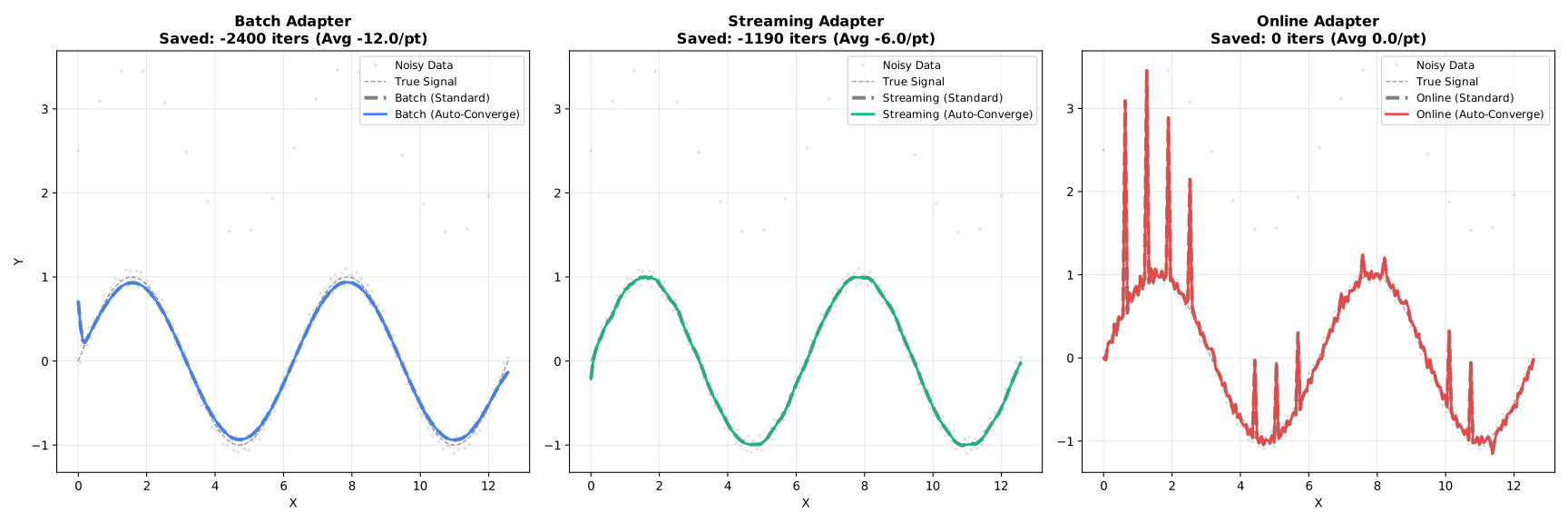
Batch Adapter
Standard mode for complete datasets. Supports all features.
When to Use
- Dataset fits in memory
- Need intervals, cross-validation, or diagnostics
- Processing complete files
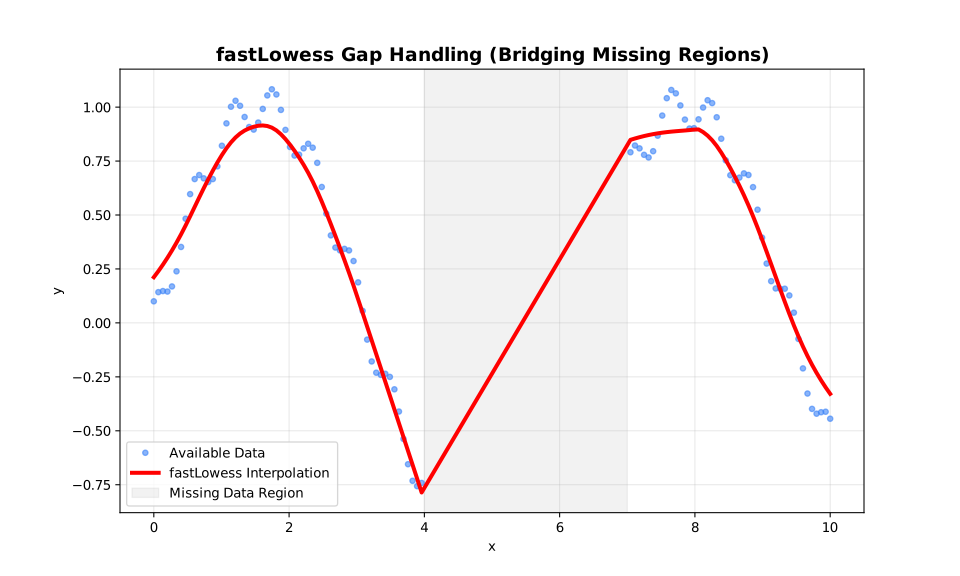
Example
import fastlowess as fl
import numpy as np

rng = np.random.default_rng(42)
x = np.linspace(0, 2 * np.pi, 100)
y = np.sin(x) + rng.normal(0, 0.3, 100)

model = fl.Lowess(
    fraction=0.5,
    iterations=3,
    confidence_intervals=0.95,
    prediction_intervals=0.95,
    return_diagnostics=True,
    parallel=True
)
result = model.fit(x, y)
use fastLowess::prelude::*;
use std::f64::consts::TAU;

fn main() -> Result<(), LowessError> {
    let n = 100usize;
    let x: Vec<f64> = (0..n).map(|i| i as f64 * TAU / (n - 1) as f64).collect();
    let y: Vec<f64> = x.iter().map(|&xi| xi.sin() + 0.1).collect();


    let model = Lowess::new()
        .fraction(0.5)
        .iterations(3)
        .confidence_intervals(0.95)
        .prediction_intervals(0.95)
        .return_diagnostics()
        .parallel(true)
        .build()?;

    let result = model.fit(&x, &y)?;

    Ok(())
}
using FastLOWESS
using Random, Statistics

rng = MersenneTwister(42)
x = collect(range(0, 2π, length=100))
y = sin.(x) .+ randn(rng, 100) .* 0.3

using FastLOWESS

model = Lowess(;
    fraction=0.5,
    iterations=3,
    confidence_intervals=0.95,
    prediction_intervals=0.95,
    return_diagnostics=true,
    parallel=true
)
result = fit(model, x, y)
const fastlowess = require('fastlowess');

const n = 100;
const x = Float64Array.from({ length: n }, (_, i) => i * 2 * Math.PI / (n - 1));
const y = Float64Array.from(x, (xi, i) => Math.sin(xi) + (((i*7+3)%17)/17-0.5)*0.6);

const model = new fastlowess.Lowess({
    fraction: 0.5,
    iterations: 3,
    confidence_intervals: 0.95,
    prediction_intervals: 0.95,
    return_diagnostics: true
});
const result = model.fit(x, y);
import init, { Lowess } from 'fastlowess-wasm';
await init();

const n = 100;
const x = Float64Array.from({ length: n }, (_, i) => i * 2 * Math.PI / (n - 1));
const y = Float64Array.from(x, (xi, i) => Math.sin(xi) + (((i * 7 + 3) % 17) / 17 - 0.5) * 0.6);

const model = new Lowess({
    fraction: 0.5,
    iterations: 3,
    confidence_intervals: 0.95,
    prediction_intervals: 0.95,
    return_diagnostics: true
});
const result = model.fit(x, y);
#include <fastlowess.hpp>
#include <cmath>
#include <iostream>
#include <vector>

int main() {
    const int n = 100;
    std::vector<double> x(n), y(n);
    for (int i = 0; i < n; ++i) {
        x[i] = i * 2 * M_PI / (n - 1);
        y[i] = std::sin(x[i]) + 0.1;
    }


    fastlowess::Lowess model({
        .fraction = 0.5,
        .iterations = 3,
        .confidence_intervals = 0.95,
        .prediction_intervals = 0.95,
        .return_diagnostics = true,
        .parallel = true
    });
    auto result = model.fit(x, y).value();

    return 0;
}
Streaming Adapter
Process large datasets in chunks with configurable overlap.
When to Use
- Dataset >100,000 points
- Memory-constrained environments
- Batch processing pipelines
Parameters
| Parameter | Default | Description |
|---|---|---|
chunk_size |
5000 | Points per chunk |
overlap |
500 | Overlap between chunks |
merge_strategy |
"weighted_average" |
How to merge overlaps |
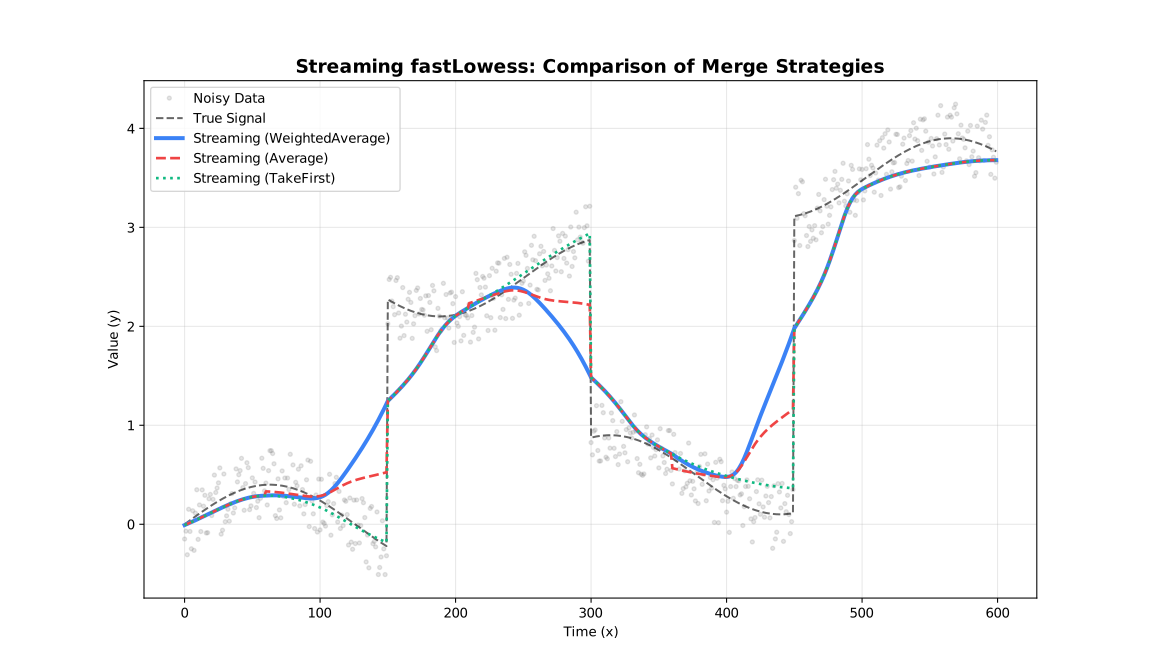
Merge Strategies
| Strategy | Behavior |
|---|---|
"average" |
Average overlapping values |
"weighted_average" |
Distance-weighted blend |
"take_first" |
Keep left chunk values |
"take_last" |
Keep right chunk values |
Example
import fastlowess as fl
import numpy as np

rng = np.random.default_rng(42)
x = np.linspace(0, 2 * np.pi, 100)
y = np.sin(x) + rng.normal(0, 0.3, 100)

model = fl.StreamingLowess(
    fraction=0.3,
    iterations=2,
    chunk_size=5000,
    overlap=500,
    merge_strategy="average"
)
model.process_chunk(x, y)
result = model.finalize()
use fastLowess::prelude::*;
use std::f64::consts::TAU;

fn write_output(_data: &[f64]) {}

fn main() -> Result<(), LowessError> {
    let n = 100usize;
    let x: Vec<f64> = (0..n).map(|i| i as f64 * TAU / (n - 1) as f64).collect();
    let y: Vec<f64> = x.iter().map(|&xi| xi.sin() + 0.1).collect();

    let data_chunks = vec![
        (x[..50].to_vec(), y[..50].to_vec()),
        (x[50..].to_vec(), y[50..].to_vec()),
    ];

    let mut processor = StreamingLowess::new()
        .build()?;

    // Process chunks (e.g., from a file reader)
    for (chunk_x, chunk_y) in data_chunks {
        let result = processor.process_chunk(&chunk_x, &chunk_y)?;
        write_output(&result.y);
    }

    // IMPORTANT: Get remaining buffered data
    let final_result = processor.finalize()?;
    write_output(&final_result.y);

    Ok(())
}
using FastLOWESS
using Random, Statistics

rng = MersenneTwister(42)
x = collect(range(0, 2π, length=100))
y = sin.(x) .+ randn(rng, 100) .* 0.3

using FastLOWESS

model = StreamingLowess(;
    fraction=0.3,
    iterations=2,
    chunk_size=5000,
    overlap=500,
    merge_strategy="average"
)
process_chunk(model, x, y)
result = finalize(model)
const { StreamingLowess } = require('fastlowess');

const n = 100;
const x = Float64Array.from({ length: n }, (_, i) => i * 2 * Math.PI / (n - 1));
const y = Float64Array.from(x, (xi, i) => Math.sin(xi) + (((i*7+3)%17)/17-0.5)*0.6);
const dataChunks = Array.from({ length: 5 }, (_, ci) => ({
    x: Float64Array.from({ length: 20 }, (_, i) => ci * 20 + i),
    y: Float64Array.from({ length: 20 }, (_, i) => Math.sin((ci * 20 + i) * 0.1))
}));

const processor = new StreamingLowess(
    { fraction: 0.3, iterations: 2 },
    { chunk_size: 5000, overlap: 500 }
);

// Process chunks
for (const {x, y} of dataChunks) {
    const result = processor.process_chunk(x, y);
    // ...
}

const finalResult = processor.finalize();
import init, { StreamingLowess } from 'fastlowess-wasm';
await init();

const n = 100;
const x = Float64Array.from({ length: n }, (_, i) => i * 2 * Math.PI / (n - 1));
const y = Float64Array.from(x, (xi, i) => Math.sin(xi) + (((i * 7 + 3) % 17) / 17 - 0.5) * 0.6);

const dataChunks = [
    { x: x.slice(0, 50), y: y.slice(0, 50) },
    { x: x.slice(50), y: y.slice(50) }
];

const processor = new StreamingLowess(
    { fraction: 0.3, iterations: 2 },
    { chunk_size: 5000, overlap: 500 }
);

// Process chunks
for (const {x, y} of dataChunks) {
    const result = processor.process_chunk(x, y);
    // ...
}

const finalResult = processor.finalize();
#include <fastlowess.hpp>
#include <cmath>
#include <iostream>
#include <vector>

int main() {
    const int n = 100;
    std::vector<double> x(n), y(n);
    for (int i = 0; i < n; ++i) {
        x[i] = i * 2 * M_PI / (n - 1);
        y[i] = std::sin(x[i]) + 0.1;
    }


    fastlowess::StreamingOptions opts;
    opts.fraction = 0.3;
    opts.iterations = 2;
    opts.chunk_size = 5000;
    opts.overlap = 500;

    fastlowess::StreamingLowess stream(opts);
    (void)stream.process_chunk(x, y);
    auto result = stream.finalize().value();

    return 0;
}
Always call finalize()
In Rust, always call processor.finalize() after processing all chunks to retrieve buffered overlap data.
Online Adapter
Incremental updates with a sliding window for real-time data.
When to Use
- Data arrives incrementally (sensors, streams)
- Need real-time smoothed values
- Fixed memory budget
Parameters
| Parameter | Default | Description |
|---|---|---|
window_capacity |
1000 | Max points in window |
min_points |
2 | Points before output starts |
update_mode |
"incremental" |
Update strategy |
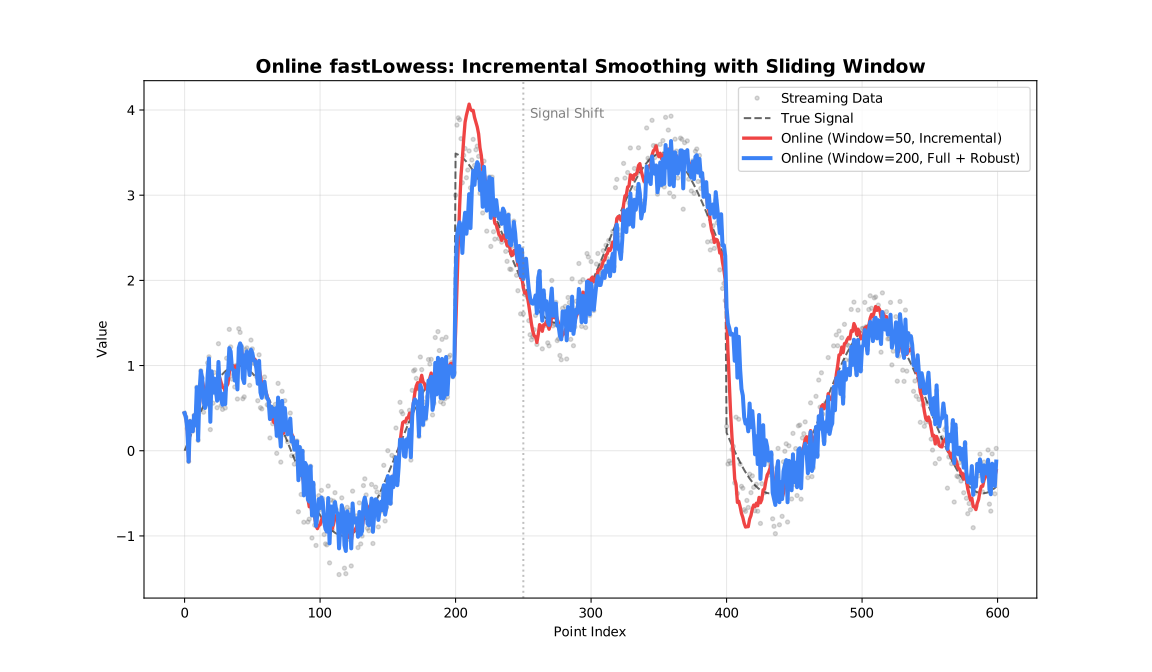
Update Modes
| Mode | Behavior | Speed |
|---|---|---|
"incremental" |
Update only affected fits | Faster |
"full" |
Recompute entire window | More accurate |
Example
library(rfastlowess)
set.seed(42)
x <- seq(0, 2 * pi, length.out = 100)
y <- sin(x) + rnorm(100, sd = 0.3)

model <- OnlineLowess(
    fraction = 0.2,
    iterations = 1,
    window_capacity = 100,
    min_points = 5,
    update_mode = "incremental"
)
smoothed <- sapply(seq_along(x), function(i) model$add_point(x[[i]], y[[i]]))
import fastlowess as fl
import numpy as np

rng = np.random.default_rng(42)
x = np.linspace(0, 2 * np.pi, 100)
y = np.sin(x) + rng.normal(0, 0.3, 100)

model = fl.OnlineLowess(
    fraction=0.2,
    iterations=1,
    window_capacity=100,
    min_points=5,
    update_mode="incremental"
)
for xi, yi in zip(x, y):
    result = model.add_point(float(xi), float(yi))
    if result is not None:
        print(result.smoothed)
use fastLowess::prelude::*;
use std::f64::consts::TAU;

fn main() -> Result<(), LowessError> {
    let n = 100usize;
    let x: Vec<f64> = (0..n).map(|i| i as f64 * TAU / (n - 1) as f64).collect();
    let y: Vec<f64> = x.iter().map(|&xi| xi.sin() + 0.1).collect();
    let sensor_stream: Vec<(f64, f64)> = x.iter().zip(y.iter()).map(|(&xi, &yi)| (xi, yi)).collect();

    let mut processor = OnlineLowess::new()
        .fraction(0.2)
        .iterations(1)
        .window_capacity(100)
        .min_points(5)
        .update_mode("incremental")
        .build()?;

    // Process points as they arrive
    for (x, y) in sensor_stream {
        if let Some(output) = processor.add_point(x, y)? {
            println!("Smoothed: {:.2}", output.smoothed);
        }
    }

    Ok(())
}
using FastLOWESS
using Random, Statistics

rng = MersenneTwister(42)
x = collect(range(0, 2π, length=100))
y = sin.(x) .+ randn(rng, 100) .* 0.3

using FastLOWESS

model = OnlineLowess(;
    fraction=0.2,
    iterations=1,
    window_capacity=100,
    min_points=5,
    update_mode="incremental"
)
for i in eachindex(x)
    result = add_point(model, x[i], y[i])
    if result !== nothing
        println(result.smoothed)
    end
end
const { OnlineLowess } = require('fastlowess');

const n = 100;
const x = Float64Array.from({ length: n }, (_, i) => i * 2 * Math.PI / (n - 1));
const y = Float64Array.from(x, (xi, i) => Math.sin(xi) + (((i*7+3)%17)/17-0.5)*0.6);
// Sensor stream as array of [xi, yi] pairs
const sensorStream = Array.from({ length: n }, (_, i) => [x[i], y[i]]);

const processor = new OnlineLowess(
    { fraction: 0.2, iterations: 1 },
    { window_capacity: 100, min_points: 5, update_mode: "incremental" }
);

// Add points
for (const [xi, yi] of sensorStream) {
    const result = processor.add_point(xi, yi);
    if (result !== null) {
        console.log(`Smoothed: ${result.smoothed.toFixed(2)}`);
    }
}
import init, { OnlineLowess } from 'fastlowess-wasm';
await init();

const n = 100;
const x = Float64Array.from({ length: n }, (_, i) => i * 2 * Math.PI / (n - 1));
const y = Float64Array.from(x, (xi, i) => Math.sin(xi) + (((i * 7 + 3) % 17) / 17 - 0.5) * 0.6);

const sensorStream = Array.from({ length: n }, (_, i) => [x[i], y[i]]);

const processor = new OnlineLowess(
    { fraction: 0.2, iterations: 1 },
    { window_capacity: 100, min_points: 5, update_mode: "incremental" }
);

// Add points
for (const [xi, yi] of sensorStream) {
    const output = processor.add_point(xi, yi);
    if (output !== undefined) {
        console.log(`Smoothed: ${output.smoothed.toFixed(2)}`);
    }
}
#include <fastlowess.hpp>
#include <cmath>
#include <iostream>
#include <vector>

int main() {
    const int n = 100;
    std::vector<double> x(n), y(n);
    for (int i = 0; i < n; ++i) {
        x[i] = i * 2 * M_PI / (n - 1);
        y[i] = std::sin(x[i]) + 0.1;
    }


    fastlowess::OnlineOptions opts;
    opts.fraction = 0.2;
    opts.iterations = 1;
    opts.window_capacity = 100;
    opts.min_points = 5;
    opts.update_mode = "incremental";

    fastlowess::OnlineLowess model(opts);
    for (size_t i = 0; i < x.size(); ++i) {
        auto out = model.add_point(x[i], y[i]).value();
        if (out.has_value())
            std::cout << out.smoothed() << std::endl;
    }

    return 0;
}
Feature Comparison
| Feature | Batch | Streaming | Online |
|---|---|---|---|
| Confidence intervals | ✓ | ✗ | ✗ |
| Prediction intervals | ✓ | ✗ | ✗ |
| Cross-validation | ✓ | ✗ | ✗ |
| Diagnostics | ✓ | ✓ | ✗ |
| Residuals | ✓ | ✓ | ✓ |
| Robustness weights | ✓ | ✓ | ✓ |
| Parallel execution | ✓ | ✓ | ✗ |
Next Steps
- Parameters — All configuration options
- Tutorials — Real-time processing guide