Intervals
Confidence and prediction intervals for uncertainty quantification.
Overview
Adapter support
Confidence and prediction intervals are available in Batch mode only. Streaming and Online modes do not support intervals.
| Type | Represents | Width | Use |
|---|---|---|---|
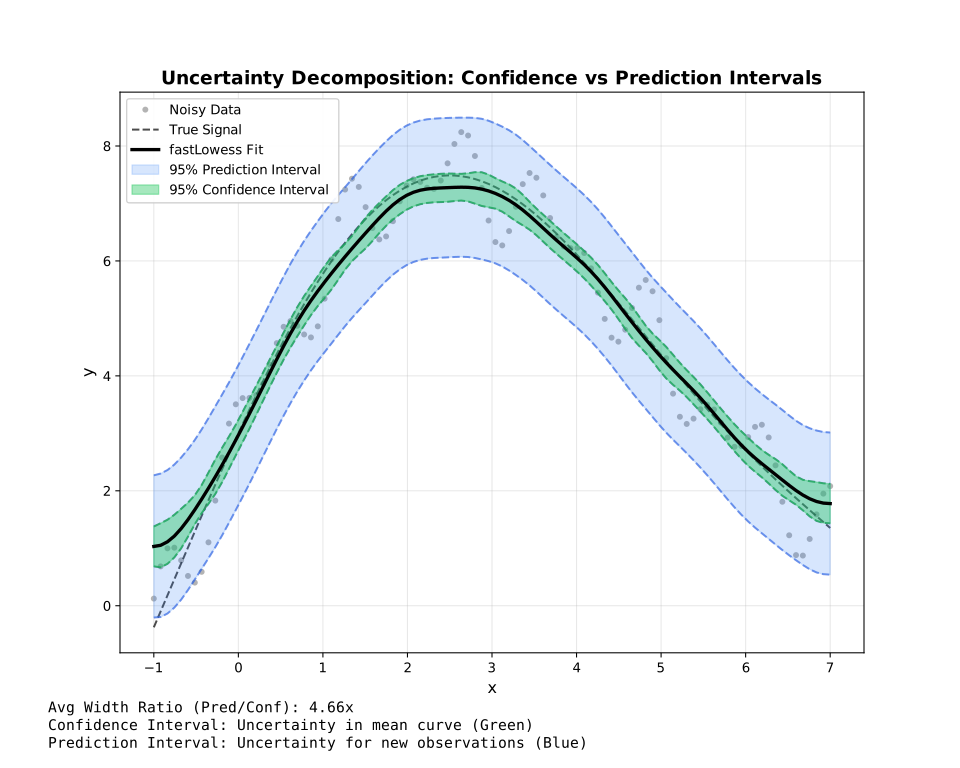
| Confidence | Uncertainty in mean curve | Narrow | Where is the true trend? |
| Prediction | Uncertainty for new points | Wide | Where will new data fall? |
Confidence Intervals
Estimate uncertainty in the smoothed curve itself.
library(rfastlowess)
set.seed(42)
x <- seq(0, 2 * pi, length.out = 100)
y <- sin(x) + rnorm(100, sd = 0.3)

model <- Lowess(fraction = 0.5, confidence_intervals = 0.95)
result <- model$fit(x, y)

# Plot with bands
plot(x, y, pch = 16, col = "gray")
lines(result$x, result$y, col = "blue", lwd = 2)
lines(result$x, result$confidence_lower, col = "blue", lty = 2)
lines(result$x, result$confidence_upper, col = "blue", lty = 2)
import fastlowess as fl
import numpy as np

rng = np.random.default_rng(42)
x = np.linspace(0, 2 * np.pi, 100)
y = np.sin(x) + rng.normal(0, 0.3, 100)

model = fl.Lowess(fraction=0.5, confidence_intervals=0.95)
result = model.fit(x, y)

print("Smoothed:", result.y)
print("CI Lower:", result.confidence_lower)
print("CI Upper:", result.confidence_upper)
use fastLowess::prelude::*;
use std::f64::consts::TAU;

fn main() -> Result<(), LowessError> {
    let n = 100usize;
    let x: Vec<f64> = (0..n).map(|i| i as f64 * TAU / (n - 1) as f64).collect();
    let y: Vec<f64> = x.iter().map(|&xi| xi.sin() + 0.1).collect();


    let model = Lowess::new()
        .fraction(0.5)
        .confidence_intervals(0.95)  // 95% CI
        .build()?;

    let result = model.fit(&x, &y)?;

    // Access intervals
    if let (Some(lower), Some(upper)) = (&result.confidence_lower, &result.confidence_upper) {
        for i in 0..result.y.len() {
            println!("x={:.2}: y={:.2} [{:.2}, {:.2}]",
                result.x[i], result.y[i], lower[i], upper[i]);
        }
    }

    Ok(())
}
using FastLOWESS
using Random, Statistics

rng = MersenneTwister(42)
x = collect(range(0, 2π, length=100))
y = sin.(x) .+ randn(rng, 100) .* 0.3

using FastLOWESS

model = Lowess(; fraction=0.5, confidence_intervals=0.95)
result = fit(model, x, y)

for i in 1:length(result.y)
    println("x=$(result.x[i]): y=$(result.y[i]) [$(result.confidence_lower[i]), $(result.confidence_upper[i])]")
end
const fl = require('fastlowess');

const n = 100;
const x = Float64Array.from({ length: n }, (_, i) => i * 2 * Math.PI / (n - 1));
const y = Float64Array.from(x, (xi, i) => Math.sin(xi) + (((i*7+3)%17)/17-0.5)*0.6);

const model = new fl.Lowess({fraction: 0.5, confidence_intervals: 0.95});
const result = model.fit(x, y);

result.y.forEach((y, i) => {
    console.log(`x=${result.x[i]}: y=${y} [${result.confidence_lower[i]}, ${result.confidence_upper[i]}]`);
});
import init, { Lowess } from 'fastlowess-wasm';
await init();

const n = 100;
const x = Float64Array.from({ length: n }, (_, i) => i * 2 * Math.PI / (n - 1));
const y = Float64Array.from(x, (xi, i) => Math.sin(xi) + (((i * 7 + 3) % 17) / 17 - 0.5) * 0.6);

const model = new Lowess({fraction: 0.5, confidence_intervals: 0.95});
const result = model.fit(x, y);

result.y.forEach((y, i) => {
    console.log(`x=${result.x[i]}: y=${y} [${result.confidence_lower[i]}, ${result.confidence_upper[i]}]`);
});
#include <fastlowess.hpp>
#include <cmath>
#include <iostream>
#include <vector>

int main() {
    const int n = 100;
    std::vector<double> x(n), y(n);
    for (int i = 0; i < n; ++i) {
        x[i] = i * 2 * M_PI / (n - 1);
        y[i] = std::sin(x[i]) + 0.1;
    }


    fastlowess::Lowess model({
        .fraction = 0.5,
        .confidence_intervals = 0.95
    });
    auto result = model.fit(x, y).value();

    auto ci_lower = result.confidence_lower();
    auto ci_upper = result.confidence_upper();

    return 0;
}
Prediction Intervals
Estimate where new observations might fall.
library(rfastlowess)
set.seed(42)
x <- seq(0, 2 * pi, length.out = 100)
y <- sin(x) + rnorm(100, sd = 0.3)

model <- Lowess(fraction = 0.5, prediction_intervals = 0.95)
result <- model$fit(x, y)

# Wider than confidence intervals
polygon(
    c(result$x, rev(result$x)),
    c(result$prediction_lower, rev(result$prediction_upper)),
    col = rgb(1, 0, 0, 0.2), border = NA
)
import fastlowess as fl
import numpy as np

rng = np.random.default_rng(42)
x = np.linspace(0, 2 * np.pi, 100)
y = np.sin(x) + rng.normal(0, 0.3, 100)

model = fl.Lowess(fraction=0.5, prediction_intervals=0.95)
result = model.fit(x, y)

print("PI Lower:", result.prediction_lower)
print("PI Upper:", result.prediction_upper)
use fastLowess::prelude::*;
use std::f64::consts::TAU;

fn main() -> Result<(), LowessError> {
    let n = 100usize;
    let x: Vec<f64> = (0..n).map(|i| i as f64 * TAU / (n - 1) as f64).collect();
    let y: Vec<f64> = x.iter().map(|&xi| xi.sin() + 0.1).collect();

    let model = Lowess::new()
        .fraction(0.5)
        .prediction_intervals(0.95)  // 95% PI
        .build()?;

    let result = model.fit(&x, &y)?;

    if let (Some(lower), Some(upper)) = (&result.prediction_lower, &result.prediction_upper) {
        println!("Prediction bounds: [{:.2}, {:.2}]", lower[0], upper[0]);
    }

    Ok(())
}
using FastLOWESS
using Random, Statistics

rng = MersenneTwister(42)
x = collect(range(0, 2π, length=100))
y = sin.(x) .+ randn(rng, 100) .* 0.3

model = Lowess(; fraction=0.5, prediction_intervals=0.95)
result = fit(model, x, y)

println("Prediction bounds: [$(result.prediction_lower[1]), $(result.prediction_upper[1])]")
const fl = require('fastlowess');

const n = 100;
const x = Float64Array.from({ length: n }, (_, i) => i * 2 * Math.PI / (n - 1));
const y = Float64Array.from(x, (xi, i) => Math.sin(xi) + (((i*7+3)%17)/17-0.5)*0.6);

const model = new fl.Lowess({fraction: 0.5, prediction_intervals: 0.95});
const result = model.fit(x, y);
console.log(`Prediction bounds: [${result.prediction_lower[0]}, ${result.prediction_upper[0]}]`);
import init, { Lowess } from 'fastlowess-wasm';
await init();

const n = 100;
const x = Float64Array.from({ length: n }, (_, i) => i * 2 * Math.PI / (n - 1));
const y = Float64Array.from(x, (xi, i) => Math.sin(xi) + (((i * 7 + 3) % 17) / 17 - 0.5) * 0.6);

const model = new Lowess({fraction: 0.5, prediction_intervals: 0.95});
const result = model.fit(x, y);
console.log(`Prediction bounds: [${result.prediction_lower[0]}, ${result.prediction_upper[0]}]`);
#include <fastlowess.hpp>
#include <cmath>
#include <iostream>
#include <vector>

int main() {
    const int n = 100;
    std::vector<double> x(n), y(n);
    for (int i = 0; i < n; ++i) {
        x[i] = i * 2 * M_PI / (n - 1);
        y[i] = std::sin(x[i]) + 0.1;
    }

    fastlowess::Lowess model({ .fraction = 0.5, .prediction_intervals = 0.95});
    auto result = model.fit(x, y).value();

    return 0;
}
Both Intervals
Request both types simultaneously:
use fastLowess::prelude::*;
use std::f64::consts::TAU;

fn main() -> Result<(), LowessError> {
    let n = 100usize;
    let x: Vec<f64> = (0..n).map(|i| i as f64 * TAU / (n - 1) as f64).collect();
    let y: Vec<f64> = x.iter().map(|&xi| xi.sin() + 0.1).collect();

    let model = Lowess::new()
        .fraction(0.5)
        .confidence_intervals(0.95)
        .prediction_intervals(0.95)
        .build()?;
    let result = model.fit(&x, &y)?;

    Ok(())
}
const fl = require('fastlowess');

const n = 100;
const x = Float64Array.from({ length: n }, (_, i) => i * 2 * Math.PI / (n - 1));
const y = Float64Array.from(x, (xi, i) => Math.sin(xi) + (((i*7+3)%17)/17-0.5)*0.6);

const model = new fl.Lowess({fraction: 0.5,
    confidence_intervals: 0.95,
    prediction_intervals: 0.95});
const result = model.fit(x, y);
import init, { Lowess } from 'fastlowess-wasm';
await init();

const n = 100;
const x = Float64Array.from({ length: n }, (_, i) => i * 2 * Math.PI / (n - 1));
const y = Float64Array.from(x, (xi, i) => Math.sin(xi) + (((i * 7 + 3) % 17) / 17 - 0.5) * 0.6);

const model = new Lowess({fraction: 0.5,
    confidence_intervals: 0.95,
    prediction_intervals: 0.95});
const result = model.fit(x, y);
#include <fastlowess.hpp>
#include <cmath>
#include <iostream>
#include <vector>

int main() {
    const int n = 100;
    std::vector<double> x(n), y(n);
    for (int i = 0; i < n; ++i) {
        x[i] = i * 2 * M_PI / (n - 1);
        y[i] = std::sin(x[i]) + 0.1;
    }

    fastlowess::Lowess model({ .fraction = 0.5, .confidence_intervals = 0.95, .prediction_intervals = 0.95});
    auto result = model.fit(x, y).value();

    return 0;
}
Confidence Levels
Common levels and their z-values:
| Level | z-value | Interpretation |
|---|---|---|
| 0.90 | 1.645 | 90% of intervals contain true value |
| 0.95 | 1.960 | 95% of intervals contain true value |
| 0.99 | 2.576 | 99% of intervals contain true value |
use fastLowess::prelude::*;
use std::f64::consts::TAU;

fn main() -> Result<(), LowessError> {
    let n = 100usize;
    let x: Vec<f64> = (0..n).map(|i| i as f64 * TAU / (n - 1) as f64).collect();
    let y: Vec<f64> = x.iter().map(|&xi| xi.sin() + 0.1).collect();

    // 99% confidence interval
    let model = Lowess::new()
        .confidence_intervals(0.99)
        .build()?;
    let result = model.fit(&x, &y)?;

    Ok(())
}
const fl = require('fastlowess');

const n = 100;
const x = Float64Array.from({ length: n }, (_, i) => i * 2 * Math.PI / (n - 1));
const y = Float64Array.from(x, (xi, i) => Math.sin(xi) + (((i*7+3)%17)/17-0.5)*0.6);

// 99% confidence interval
const model = new fl.Lowess({confidence_intervals: 0.99});
const result = model.fit(x, y);
import init, { Lowess } from 'fastlowess-wasm';
await init();

const n = 100;
const x = Float64Array.from({ length: n }, (_, i) => i * 2 * Math.PI / (n - 1));
const y = Float64Array.from(x, (xi, i) => Math.sin(xi) + (((i * 7 + 3) % 17) / 17 - 0.5) * 0.6);

// 99% confidence interval
const model = new Lowess({confidence_intervals: 0.99});
const result = model.fit(x, y);
#include <fastlowess.hpp>
#include <cmath>
#include <iostream>
#include <vector>

int main() {
    const int n = 100;
    std::vector<double> x(n), y(n);
    for (int i = 0; i < n; ++i) {
        x[i] = i * 2 * M_PI / (n - 1);
        y[i] = std::sin(x[i]) + 0.1;
    }

    fastlowess::Lowess model({ .confidence_intervals = 0.99});
    auto result = model.fit(x, y).value();

    return 0;
}
Standard Errors
Access standard errors directly (available when intervals are computed):
use fastLowess::prelude::*;
use std::f64::consts::TAU;

fn main() -> Result<(), LowessError> {
    let n = 100usize;
    let x: Vec<f64> = (0..n).map(|i| i as f64 * TAU / (n - 1) as f64).collect();
    let y: Vec<f64> = x.iter().map(|&xi| xi.sin() + 0.1).collect();

    let model = Lowess::new().return_se().build()?;
    let result = model.fit(&x, &y)?;

    if let Some(standard_errors) = &result.standard_errors {
        for (i, &se) in standard_errors.iter().enumerate() {
            println!("Point {}: SE = {:.4}", i, se);
        }
    }

    Ok(())
}
const fl = require('fastlowess');

const n = 100;
const x = Float64Array.from({ length: n }, (_, i) => i * 2 * Math.PI / (n - 1));
const y = Float64Array.from(x, (xi, i) => Math.sin(xi) + (((i*7+3)%17)/17-0.5)*0.6);

const model = new fl.Lowess({confidence_intervals: 0.95});
const result = model.fit(x, y);

result.standard_errors.forEach((se, i) => {
    console.log(`Point ${i}: SE = ${se.toFixed(4)}`);
});
import init, { Lowess } from 'fastlowess-wasm';
await init();

const n = 100;
const x = Float64Array.from({ length: n }, (_, i) => i * 2 * Math.PI / (n - 1));
const y = Float64Array.from(x, (xi, i) => Math.sin(xi) + (((i * 7 + 3) % 17) / 17 - 0.5) * 0.6);

const model = new Lowess({confidence_intervals: 0.95});
const result = model.fit(x, y);

result.standard_errors.forEach((se, i) => {
    console.log(`Point ${i}: SE = ${se.toFixed(4)}`);
});
#include <fastlowess.hpp>
#include <cmath>
#include <iostream>
#include <vector>

int main() {
    const int n = 100;
    std::vector<double> x(n), y(n);
    for (int i = 0; i < n; ++i) {
        x[i] = i * 2 * M_PI / (n - 1);
        y[i] = std::sin(x[i]) + 0.1;
    }

    fastlowess::Lowess model({ .confidence_intervals = 0.95});
    auto result = model.fit(x, y).value();

    return 0;
}
Availability
Batch Mode Only
Confidence and prediction intervals are only available in Batch mode. Streaming and Online modes do not support intervals.
| Feature | Batch | Streaming | Online |
|---|---|---|---|
| Confidence intervals | ✓ | ✗ | ✗ |
| Prediction intervals | ✓ | ✗ | ✗ |
| Standard errors | ✓ | ✗ | ✗ |